Regression Testing Pipelines for Iterative Model Releases
Catch model degradation before production with automated gold-set testing.
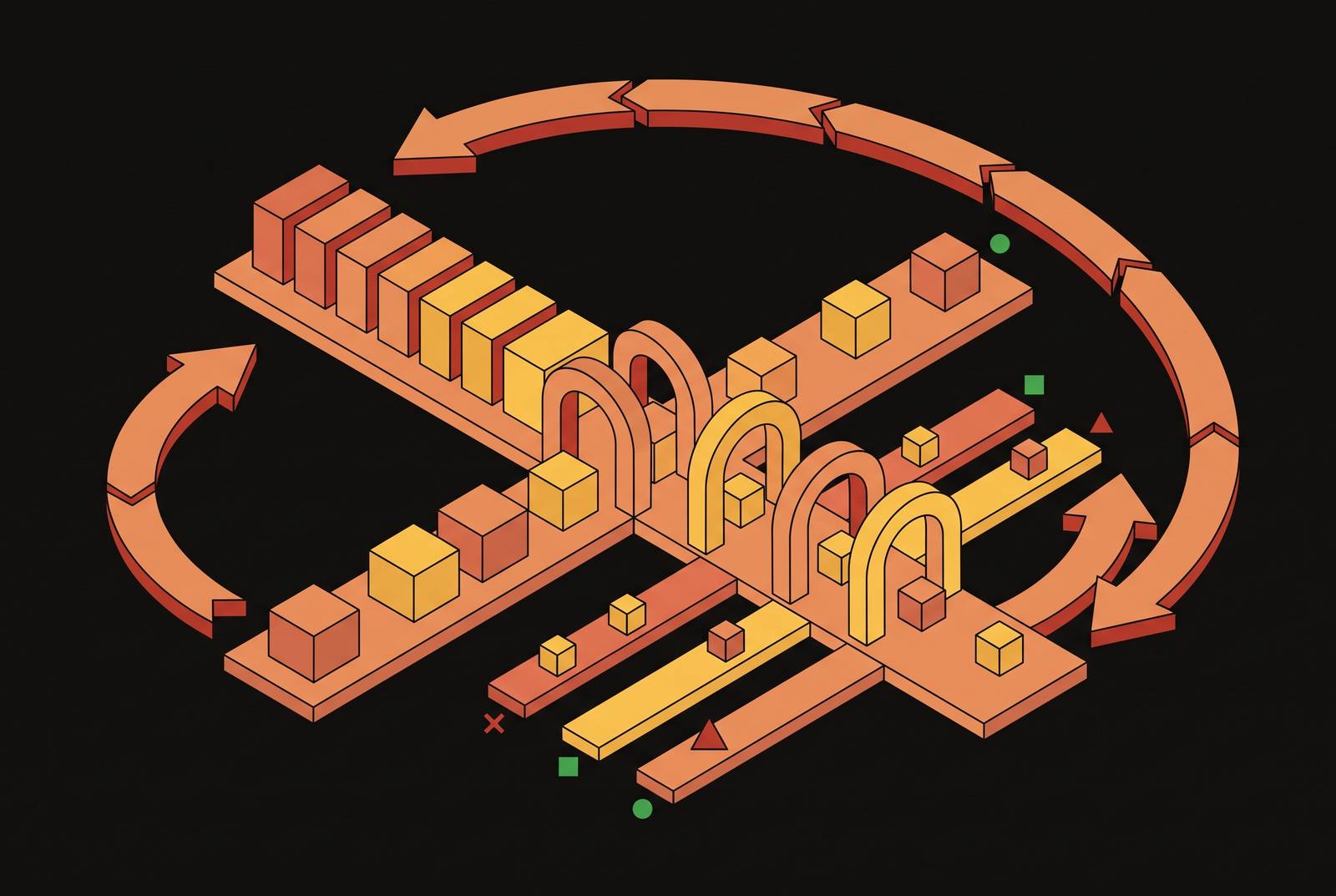
A prompt edit ships. A retrieval config changes. A model gets swapped for a cheaper variant. Every unit test passes, every request comes back HTTP 200, but the answers you get are measurably worse. This is the central problem iterative model releases create, and it is the problem this piece works through: a structured regression testing pipeline built on gold sets, automated scoring, CI/CD gates, and ongoing baseline management.
Why iterative model releases create failures conventional testing cannot see
Traditional software testing rests on a simple premise: a given input produces a deterministic output, and when that output breaks, an assertion fails somewhere and someone notices. A button that used to render now doesn't. A function that used to return a value now throws an error. The failure is binary, and it's visible the moment it happens.
Large language model systems don't work this way. Inference depends on sampling and temperature, so if you run a prompt twice, you can get two different strings back even though both are correct. There is no fixed string to assert against, and that means there is no clean failure to catch when quality actually drops. A prompt edit, a model swap, a change to retrieval configuration, or a weight fine-tune can each quietly reduce faithfulness or answer relevance, and the application will keep returning HTTP 200 and passing every unit test on the books. In an agent pipeline, a code change can pass the final response check while breaking a tool call buried in the middle of the trace, invisible to anyone only watching the end result.
Teams have long patched this gap with manual review: they run a dozen prompts through a staging UI and judge by feel whether the model still seems accurate. That approach depends on how alert the reviewer happens to be that day, skews toward whatever was tested most recently, and can't begin to cover the combinatorial range of edge cases a model meets once it's live. If a team ships multiple releases a day, it cannot sustain a review process whose cost scales linearly with release frequency. The real question for CI/CD in AI applications is whether a given change made the model's behavior worse, and whether you should stop that change before it reaches production. Answering that question requires replacing subjective review with something structural, which is what the rest of this pipeline is built to do.
Why gold sets are the foundational requirement for any pipeline component
Nothing later, the scoring, the gating, the automation, means anything if you have no baseline to measure against, and that baseline is the gold set. A gold set is a curated collection of test cases defining correct behavior for a specific use case, built deliberately. Each case is annotated to reflect the exact behavior the model should produce, across a deliberate range of simple and complex scenarios.
Each record in a gold set carries four elements: the input prompt, the expected output, the context the model needs to answer correctly, and the criteria by which an answer gets judged. These records are typically stored in a machine-readable format such as JSONL, so an evaluation pipeline can parse thousands of them automatically.
Building a gold set that actually catches regressions means collecting across a matrix of case types, not just the easy ones. Standard queries belong in the set, but so do adversarial cases such as prompt injection attempts, inputs that are genuinely ambiguous and require the model to ask for clarification, and requests entirely outside the model's domain that it should decline gracefully. Coverage across these categories is what makes the set statistically useful for catching regressions, rather than a set that only confirms the model still handles the easy cases it was always going to handle. A production gold set typically runs between 100 and 300 diverse, non-overlapping prompt-response pairs, a range large enough to carry statistical weight without making every CI run computationally expensive.
Many teams make the mistake of building the gold set once at launch and then leaving it alone. A static gold set ages: the application starts fielding real-world queries nobody anticipated, and if those queries never make it back into the gold set, the pipeline keeps reporting green while its coverage of what users actually ask grows narrower by the week. Gold sets need to function as living repositories. As the application meets novel queries in production, those interactions should get reviewed, corrected where needed, and folded back into the gold set, so the benchmark tracks what users actually ask, break, and care about.
How automated scoring replaces human judgment at scale
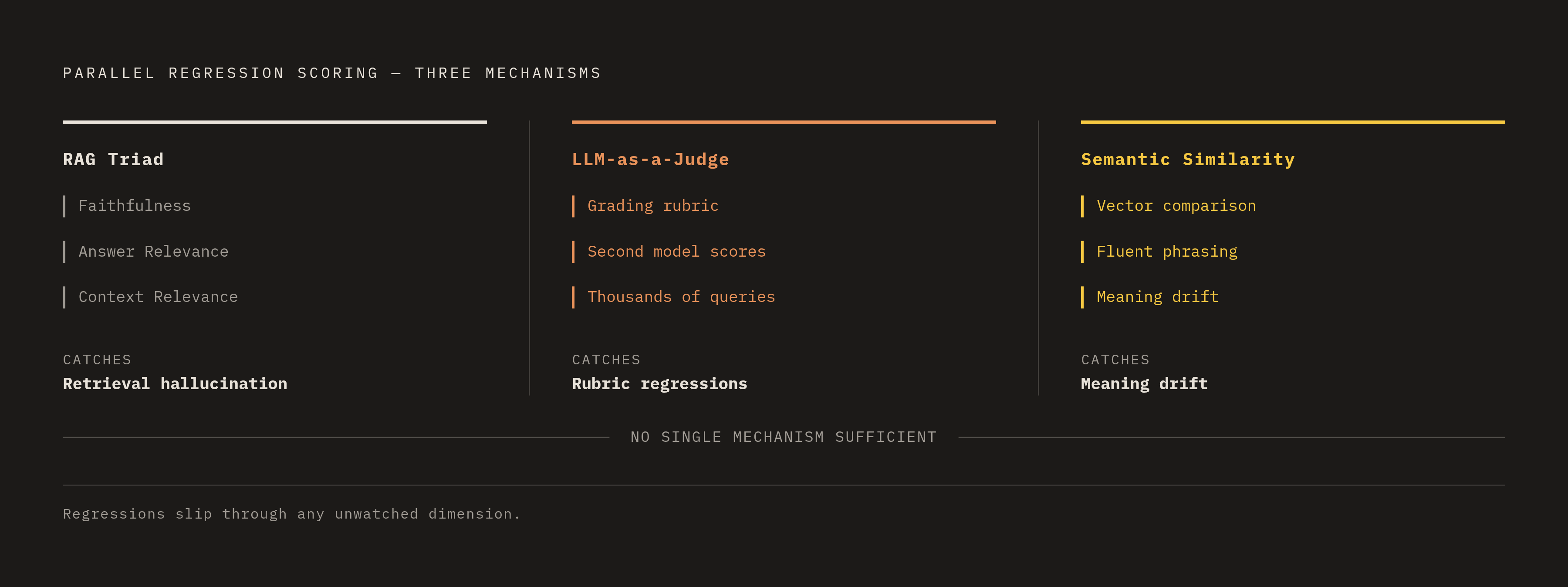
Once you have a gold set, you still need a way to score a model's output against it without a human reading every response. Automated scoring answers this by replacing subjective judgment with evaluation frameworks that calculate exact deltas across accuracy, safety, and format compliance, turning "did quality drop?" into a question with a number attached.
Three scoring mechanisms work together here, and each one catches what the others miss. The RAG Triad, a continuous measurement of Faithfulness, Answer Relevance, and Context Relevance, catches hallucination that sneaks through a retrieval pipeline when a retrieval configuration changes. Faithfulness catches fabricated claims. Answer relevance catches responses that drift off the question being asked. Context relevance catches answers built on retrieved material with no bearing on the query. Each dimension is checking a separate point of failure, and a system that only tracks one of the three can still ship a regression through the other two.
LLM-as-a-Judge uses a second language model, configured against a defined grading rubric, to score the outputs of the model under test. This does not require an especially large or expensive model; smaller, faster models can serve as graders, receiving an evaluation prompt that contains the criterion, the input, and the generated output, and returning a numeric score. The practical payoff is scale: an automated pipeline can run thousands of targeted queries against a new model version or prompt update in minutes, quantifying whether a temperature adjustment or a system prompt rewrite degraded performance across the full range of historical use cases, something no human reviewer could do in the same window.
Semantic similarity scoring solves a different problem: the non-determinism built into language generation itself. Two correct answers can use entirely different words and both deserve to pass. A vector-based comparison measures how close a generated response sits to the expected baseline in meaning, not in exact phrasing, so a response that drifts in substance fails the check even if it reads fluently.
A scoring layer needs an industry-grade metric suite spanning single-turn, conversational, span-level, trace-level, and thread-level evaluation, because a shallow metric set is worse than no dashboard at all: it produces false confidence at the exact moment a release gate is supposed to stop a bad change. At the scale a real gold set runs at, thousands of cases produce thousands of results, so the scoring layer also has to cluster failures and summarize what's going wrong, so reviewers see the specific failing slices that matter.
Where the release gate lives in the CI/CD pipeline
Scoring only matters if it sits at a point in the pipeline with the power to stop a release. Embedding evaluation as a required check on every pull request, rather than a scheduled report someone reads after the fact, is what turns a measurement system into an actual gate.
Automated regression testing runs a test suite programmatically after every commit, during every pull request, and before deployment, with no human needed to trigger it. The decision to block a release sits inside the pipeline itself, so it doesn't depend on someone remembering to check a dashboard. A layered strategy distributes checks across pipeline stages to balance speed against coverage: test selection runs only the checks relevant to what changed, so a prompt edit triggers prompt regression tests and a retrieval change triggers RAG Triad checks, giving engineers feedback before a full suite finishes running. You reserve full regression against the entire gold set for major releases or for changes whose downstream effects you don't fully understand yet.
The gate logic itself is direct: if a prompt or model update drops the faithfulness score, the answer relevance score, or the semantic similarity score below an accepted threshold, the deployment fails. Every CI run should produce a durable report linking the test result, the score movement, the specific failed cases, and enough context for a reviewer to understand the release decision, leaving behind an auditable record.
The sharpest objection to this design is that non-deterministic metrics can make the gate flap, returning different scores on the same commit from one run to the next, which trains engineers to disable the check out of frustration. The fix is to set a fixed random state, pin the evaluation data, and gate against a held-out set so the evaluation is reproducible. A gate that fails at random is a test-design problem, and it needs to be fixed at that level. The gate has to be reliable before it can be trusted to gate anything else, and that bootstrapping discipline is what separates a mature regression pipeline from a fragile one that gets switched off the first time it's inconvenient. Automated scoring without an enforced gate is a faster way to watch a regression happen.
MLflow and dbt integration into engineering workflows
The fastest route to actually getting a team to adopt this kind of testing is making it look like the testing they already do, not a separate system bolted on beside the main codebase.
MLflow offers one of the clearest paths here. With its pytest integration, a team can write GenAI regression tests as ordinary pytest functions marked with @mlflow.test, gate them inside CI, and review test history along with per-assertion judge results right in the MLflow UI. Practically, this means when a team changes an agent, whether that's a new prompt, a swapped model, or a refactored tool, the same test-and-run-in-CI workflow already used for the rest of the code now covers the model's behavior too. Engineers don't need to learn a second toolchain to know whether a change regressed.
At the data transformation layer, dbt's Slim CI cuts the cost of running full regression all the time. Full CI builds every model in the project, appropriate for major refactors or a complete regression pass. Slim CI with defer builds only the models that changed along with their downstream dependencies, which is the right default for standard pull request validation. This mirrors the same layered logic used in the gate itself: full coverage when the blast radius of a change is unclear, targeted coverage when it's incremental and well understood.
Confident AI occupies a different layer of the same problem, focused specifically on managing prompts and models as release artifacts. Prompt changes move through review, evaluation against thresholds, and promotion before they ever touch production, using prompt branches, merge rules, pull requests, and eval actions to turn a prompt edit into a reviewable release event. It sits among a set of tools built for LLM evaluation in CI/CD, alongside Ragas, Langfuse, LangSmith, LangWatch, Braintrust, Arize/Phoenix, and Humanloop, each addressing some piece of the same evaluation and release problem from a slightly different angle.
Baseline management for the evolving regression pipeline
A regression pipeline that nobody tends to eventually turns into the exact failure mode it was meant to catch: a system that reports green while actual quality drifts beneath it, because without upkeep the dashboard stops tracking what it was built to measure.
Baseline management covers three distinct jobs. Threshold calibration means revisiting score thresholds as the gold set and the model both change over time. A threshold set conservatively at version one might become trivial to clear by version five, or it might block a genuinely valid improvement if nobody updates the baseline you measure it against. Gold set refresh means you review production traces that surface new kinds of failures and fold the useful ones back into the gold set on a regular schedule, because a gold set that stops growing tests an ever-narrower slice of what the application actually encounters. Version tracking means every baseline involved in a release decision, the gold set version, the scoring thresholds, the model version under test, gets versioned and tied to that decision, so a team can later reconstruct what a given promotion was measured against and pinpoint when a regression first entered the system.
Beyond these three, mature teams track quality movement across benchmarks and datasets over time and attribute shifts in that movement to specific prompts, models, parameters, or other release variables. That attribution work is what turns the gate from a simple pass or fail switch into a tool for understanding how the model is actually changing release over release. At full MLOps maturity, performance monitoring runs continuously and retraining triggers automatically when drift is detected, with the entire loop running without manual intervention. Baseline management is the discipline that makes that level of automation sustainable instead of dangerous, because automation without a well-tended baseline just means a system that fails faster and with less human awareness of what went wrong.
None of this holds if the underlying data is unreliable. A regression pipeline evaluating model outputs is only as trustworthy as the data the model is working from. If the retrieval corpus is stale, if CRM records are inconsistent, or if the system-of-record data feeding the model doesn't match production reality anymore, the evaluation ends up validating the model's behavior against inputs that no longer describe the world the model is actually operating in. Keeping that underlying data reliable at the source is what keeps the entire baseline honest, and it's the condition every other part of this pipeline, gold sets, scoring, gates, and tooling, quietly depends on.
Sources
- The True Cost of Poor Data Quality
- Human-AI Collaboration for Scaling Agile Regression Testing: An Agentic-AI Teammate from Manual to Automated Testing
- Automated Self-Testing as a Quality Gate: Evidence-Driven Release Management for LLM Applications
- Model Deployment Pipelines: The Backbone of Reliable MLOps
- Regression Testing and CI/CD