Benchmark Overfitting in NLP Evaluation
Models exploit benchmark quirks rather than develop real reasoning skills.

Benchmark overfitting happens when a model gets better at scoring well on a specific test rather than better at the thing the test was supposed to measure. Benchmark overfitting is close to the default outcome of static evaluation in a field where the same handful of benchmarks get reused for years, and where the pretraining corpora keep growing to include more and more of... It is close to the default outcome of static evaluation in a field where the same handful of benchmarks get reused for years, and where the pretraining corpora keep growing to include more and more of the internet, including, often, the benchmarks themselves.
Benchmark scores versus model capability
Leaderboards are how NLP talks about progress. A score on MMLU or HellaSwag or GPQA gets treated as a stand-in for how capable a model actually is, and papers, product pages, and press releases all lean on that shorthand. The gap between a benchmark score and real capability is structural and predictable once you know where to look. It's structural, and it's predictable once you know where to look.
The economist and computer scientist framing that fits best here is Goodhart's Law: when a measure becomes a target, it stops being a good measure. Applied to static NLP benchmarks, this means the moment a benchmark becomes the thing labs optimize against, its ability to reflect genuine skill starts to erode. Model developers know which tests matter for marketing, so training decisions, fine-tuning data, and even hyperparameter choices drift toward whatever maximizes the score on those tests specifically.
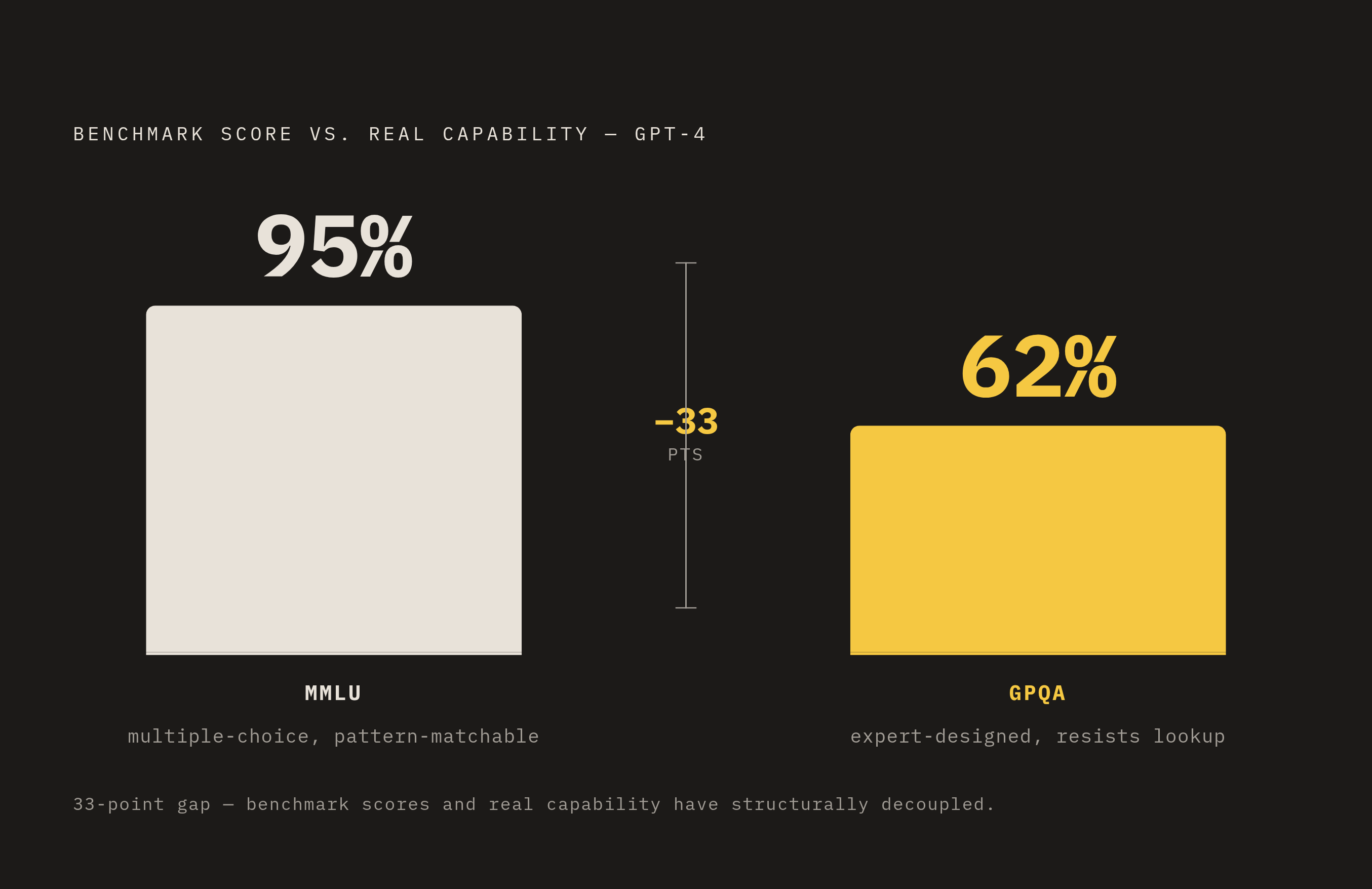
The clearest illustration of this drift is the spread between two benchmarks that are both supposed to measure reasoning. GPT-4 variants score around 95% on MMLU, a benchmark built from multiple-choice questions across dozens of academic subjects, but drop to roughly 62% on GPQA, a benchmark designed by domain experts to resist easy lookup or pattern-matching. A 33-point gap between two tests that both claim to measure knowledge and reasoning doesn't happen by chance. It happens because MMLU has been around long enough, and is structured simply enough, that models have been optimized toward it in ways that don't transfer to GPQA's harder, less guessable questions.
How test-set contamination inflates scores without improving models
Contamination means overlap between a benchmark's test items and the text a model was pretrained on. If a model has seen the exact questions and answers from a benchmark during training, however that happened, its score on that benchmark no longer tells anyone much about generalizable skill. It tells you the model memorized part of the answer key.
This isn't a hypothetical risk analysts worry about in the abstract. The LLaMA-2 technical report found that over 16% of MMLU samples showed contamination. Controlled experiments on the effect of contamination show that even limited overlap between training data and test data causes real score inflation. Contamination inflates scores in ways that can distort how progress gets measured across the field.
Frontier models train on such enormous slices of public text that a benchmark's "hidden" test set gets absorbed without anyone deliberately feeding it in. A benchmark that was genuinely unseen at the moment of its creation can become partially contaminated within months, once papers discussing it, forum threads quoting its questions, and blog posts analyzing its answers get published and then scraped into the next training run. The benchmark doesn't need to leak on purpose; it just needs to exist long enough in public view. It just needs to exist long enough in public view.
Dataset artifacts: when models learn the test's quirks instead of the underlying skill
Contamination is about what ends up in the training data. Artifacts are a separate problem: they're about what's structurally wrong with the benchmark itself, independent of whether any model has seen the exact questions before. Both inflate scores, but for different reasons, and conflating them leads to the wrong fix.
Research from Chizhov and colleagues found that when question prompts in HellaSwag get removed entirely, or replaced outright with placeholder text like "Lorem ipsum dolor," more than 65% of model pre... Research from Chizhov and colleagues found that when question prompts in HellaSwag get removed entirely, or replaced outright with placeholder text like "Lorem ipsum dolor," more than 65% of model predictions don't change. Read that carefully: the model is supposedly choosing the most plausible continuation of a described scenario, but stripping out the scenario description barely moves its answer. The model isn't reasoning about the situation. It exploits structural cues in the answer options themselves, things like length, phrasing patterns, or statistical regularities that have nothing to do with commonsense understanding, and these cues produce the model's choice without any reasoning about the situation.
Documented validity problems in HellaSwag go beyond that one finding, too. Researchers have catalogued ungrammatical prompts, typos, misleading setups, and answer options that are arguably equally correct, all issues that reward a model for spotting surface patterns rather than reasoning through the scenario the way a human would. Add prompt sensitivity on top of that: model rankings shift when the prompt format gets perturbed even slightly. A benchmark score is partly a score on one specific way of phrasing the question, not a stable read on capability.
Benchmark saturation: what happens when tests stop being able to distinguish models
Saturation is what happens when the top models cluster so close to a benchmark's ceiling that the test can no longer tell them apart in any statistically meaningful way. Everyone's scoring in the mid-90s, the differences between models shrink to fractions of a percentage point, and the benchmark stops doing its job.
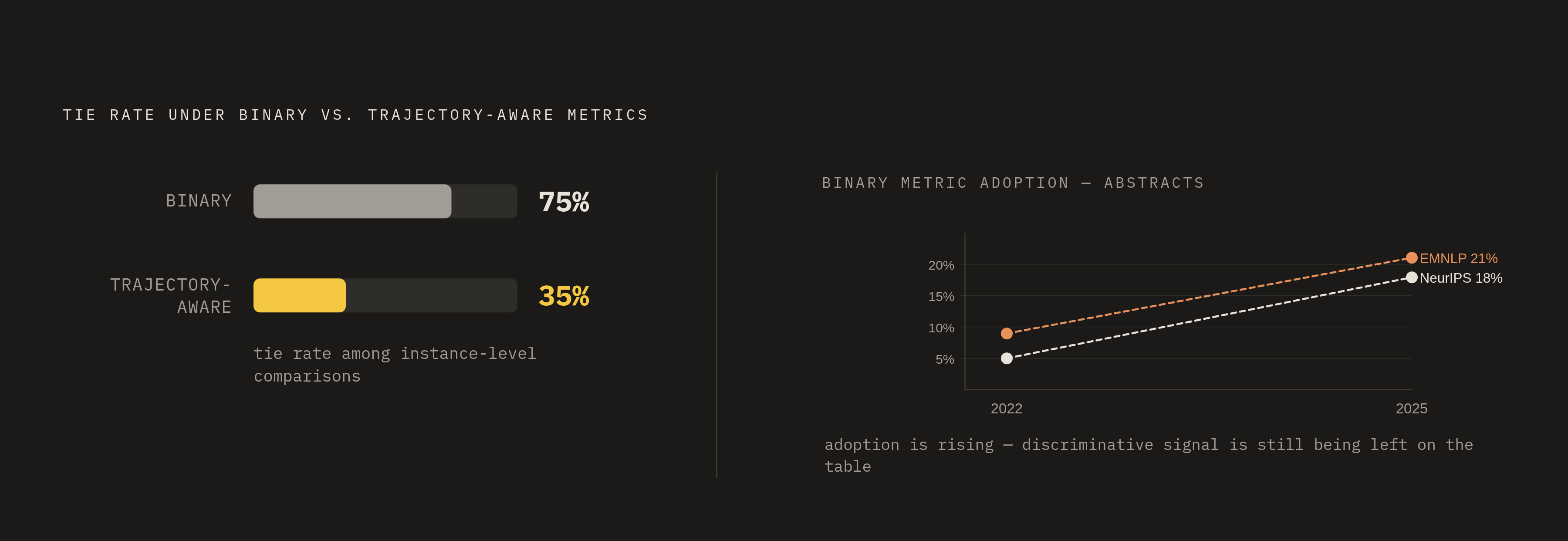
Research from Carnegie Mellon (Diaz) puts a number on a related version of this problem. Under standard binary success-rate metrics, applied across a range of agentic and interactive benchmarks, roughly 75% of instance-level comparisons between two systems come out as ties. The metric simply can't distinguish one model's performance from another's on three out of four tasks. Switching to trajectory-aware preference metrics, which look at how a model got to an answer rather than just whether the final answer matched, cuts that tie rate down to roughly 35%, recovering a meaningful amount of discriminative signal. That's a striking result, because it suggests saturation is at least partly a measurement-choice problem, where the metric itself is throwing away information that's actually there in the data. It's partly a measurement-choice problem, where the metric itself is throwing away information that's actually there in the data.
And yet adoption is moving in the wrong direction. The share of NeurIPS Datasets and Benchmarks abstracts mentioning binary metrics rose from 5% in 2022 to 18% in 2025. At EMNLP, the same figure climbed from 9% in 2022 to 21% in 2025. Binary metrics are becoming more common in the field's own research output at precisely the moment evidence shows they're losing their ability to distinguish models.
How leaderboard infrastructure turns evaluation problems into marketing problems
Static leaderboards don't just measure capability, they shape it. When a leaderboard rewards training-to-the-test, contamination, and clever presentation over demonstrated skill, that's what the infrastructure ends up optimizing for, because that's what gets rewarded.
Vendor-reported scores at a model's launch function as marketing claims until someone reproduces them independently, a point consistent with the structural incentives of model releases. That's not a cynical read, it's a description of incentives: a company announcing a new model has every reason to report the benchmark configuration that makes the model look best, and no particular obligation to report the ones that don't.
Aggregation methods compound the problem. Uniform benchmark averaging, where every benchmark counts equally toward an overall score, gives disproportionate implicit weight to whatever capabilities happen to be tested by the most benchmarks, rather than the capabilities that matter most in practice. On WildScores, a dataset built from 148 developer-reported benchmarks and 5,371 observed scores, uniform standardized averaging produces a Spearman correlation of only 0.764 with held-out performance, a real gap from what smarter aggregation methods can achieve. That gap represents real information lost simply because of how scores got combined, not because of anything wrong with the underlying models.
Research from Cruz and Aji at MBZUAI formalizes another layer of this: open benchmarks invite heavy iteration on prompts and evaluation settings, and even the order in which few-shot examples get presented can shift a model's score. "Few-shot ability" reported in a paper or a product announcement can be overstated substantially when the prompts behind it were tuned in ways that don't resemble how a model would actually be used in a no-development, first-try evaluation.
Detecting and Correcting for Benchmark Overfitting
Detecting overfitting starts with a simple heuristic: test the model on held-out benchmarks that share a similar domain but a different construction method, like GPQA, ARC-Challenge, or IFEval, and watch what happens to the score. A meaningful drop between a familiar benchmark and one of these held-out tests is a signal that the score may be inflated.
From there, a few concrete habits separate careful evaluation from marketing theater. Training on diverse benchmark sources, instead of optimizing narrowly for a single suite, resists the temptation to chase one leaderboard's specific quirks. Few-shot evaluation without in-distribution priming keeps the test closer to how a model behaves on genuinely new material. Adversarial variants, CounterFact for factuality being one concrete example, stress-test whether a model's apparent knowledge holds up when the framing changes. Hyperparameters shouldn't get tuned excessively against the dev set either, since that's a distinct overfitting mode from contamination, one that happens entirely within a lab's own evaluation pipeline and has nothing to do with what leaked into pretraining. And outdated dataset versions or mismatched splits need to stay out of the comparison altogether, because mixing them quietly reintroduces the exact contamination problem the rest of the checklist is trying to avoid.
Statistically, leaderboard comparisons drawn from small benchmarks, ones with only a few hundred datapoints, deserve to be treated as noisy estimates rather than definitive rankings. A model that beats another by two points on a benchmark with only a few hundred questions hasn't necessarily demonstrated anything durable. Independent evaluators who publish their raw data deserve more weight than vendor-self-reported numbers, simply because the incentive structure runs in the opposite direction.
Emerging evaluation formats designed to resist the failure modes described above
Each newer benchmark on the scene tends to target one specific failure mode described above, rather than trying to fix evaluation broadly.
Against contamination, LiveBench, presented at ICLR 2025, was built specifically as a contamination-limited benchmark. AntiLeakBench takes a different approach to the same problem: it automatically constructs benchmarks using updated real-world knowledge, which prevents contamination by design rather than trying to detect it after the fact. ARC-AGI-2 targets a related but distinct goal, testing fluid reasoning through grid transformation puzzles instead of knowledge retrieval, so that memorizing text doesn't help. In the ARC Prize 2025 competition, 1,455 teams competed, and the top private-set score reached just 24%, a ceiling nowhere close to the saturation levels described earlier.
Against saturation itself, benchmarks like MixEval and MMLU-Pro introduce novelty and harder reasoning tasks, aiming to push models toward deeper understanding rather than letting them plateau near the ceiling of an older, easier test.
And against cherry-picking and prompt-tuning specifically, human-preference formats offer a different foundation. LMArena, formerly known as LMSYS Chatbot Arena, collects pairwise human preference votes between two anonymized models answering the same prompt, then ranks the models using a Bradley-Terry maximum-likelihood estimator, the same statistical approach used for ranking chess players and sports teams from head-to-head results. By early 2026, the platform had accumulated roughly six million votes, the largest public human-preference dataset built for comparing language models. The platform's design, collecting pairwise votes between anonymized models at large scale, is structured differently from the vendor-reported static benchmarks described earlier.
Benchmark Overfitting and Model Trust and Deployment Decisions
Benchmark overfitting matters well beyond academic conferences arguing over footnotes. It's a mechanism, operating right now, by which model capability gets systematically misrepresented to the people who have to decide whether to deploy these systems in production.
Anyone reading a benchmark score attached to a new model release should treat that number as a claim awaiting verification, not a fact already settled, especially when the only evaluation available is one the vendor ran on public benchmarks before any independent group reproduced it. The 33-point spread between MMLU and GPQA points to a deeper and less comfortable principle: any evaluation system left unmaintained against gaming will, eventually, get gamed. It's a symptom of a deeper and less comfortable principle: any evaluation system that isn't actively maintained against gaming will, eventually, get gamed.
That principle doesn't stop at model selection for chatbots and coding assistants. Any system where AI outputs get trusted for something consequential, forecasting, scoring, routing, enrichment, whatever the application, is only as reliable as the evaluation framework that validated it in the first place and the data that framework was built on. Get the evaluation wrong, and everything built on top of it inherits the same blind spot.