Domain Shift Detection in Training vs Evaluation Distributions
Models drift silently in production when training and real-world data diverge.

Domain shift detection is the discipline of catching, before or after deployment, the moment when the gap between a model's training data and its real-world evaluation data grows wide enough to compromise what the model predicts. Cross-validation, the standard technique teams rely on to estimate how a model will perform, rests on one assumption: training data and evaluation data come from the same distribution. That assumption gets violated constantly in production settings, and when it breaks, test accuracy stops meaning what everyone assumes it means. The model hasn't changed. Its reliability has, quietly, without anyone touching a line of code.
A useful case shows what this looks like at scale. At a Fortune 500 healthcare company, patient outcome predictions came in 30% off from reality, and the cause traced back to a silent data pipeline failure that fed the model incomplete records for more than three weeks before anyone noticed Data Reliability in 2025: Complete Guide to Ensuring Trustworthy Data…. Nobody retrained the model. Nobody changed its architecture. The data feeding it simply stopped matching the world the model was built to understand, and the predictions rotted from the inside while every dashboard kept reporting green.
This isn't a rare failure mode reserved for unlucky teams. It's the default condition for any model that stays in production long enough to matter. Conditions shift, customer behavior evolves, upstream systems get patched, and the model, static by design, never gets a memo about any of it. Strong benchmark performance tells a team the model learned its training set well. It says nothing about whether that training set still resembles the world the model now operates in, which is exactly why benchmark performance is a necessary condition for trustworthy deployment, not a sufficient one.
The sections that follow build out a working map: the vocabulary practitioners use to describe different flavors of shift, why algorithms alone can't solve the problem, how detection systems actually catch drift in practice, and what to do once a shift gets confirmed. The goal is to hand practitioners a framework they can apply the next time a model that passed every test starts quietly getting things wrong.
The vocabulary of distribution shift: covariate shift, concept drift, and diversity shift
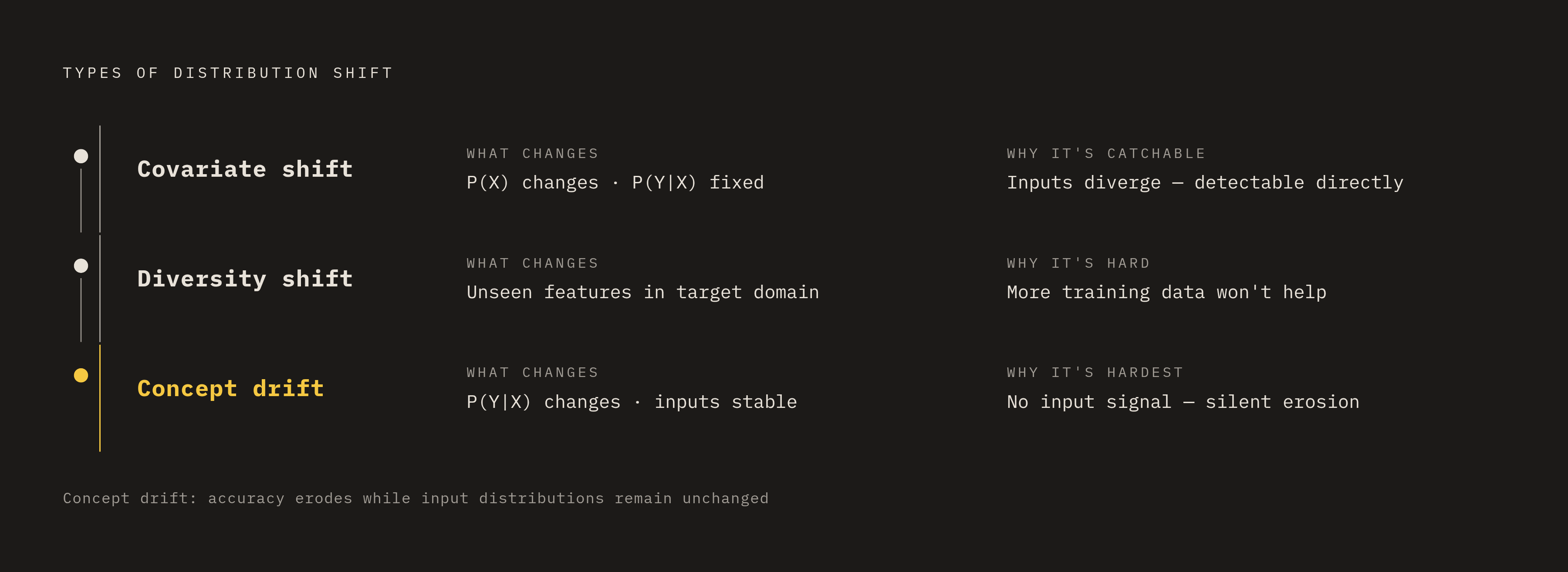
Distribution shift comes in more than one shape, and the differences matter because they change what a team should even look for. Covariate shift describes a situation where the distribution of inputs changes, P(X), but the true relationship between inputs and outputs, P(Y|X), stays fixed. A fraud detection model trained on desktop transaction patterns and then deployed against a mobile-first customer base runs into exactly this problem: the inputs look different, but the underlying logic connecting transaction features to fraud risk hasn't moved. Covariate shift is, in a sense, the more forgiving failure mode. It's detectable by comparing input distributions directly, and the model's decision rule remains sound, provided it can actually see the new inputs clearly enough to apply that rule.
Concept drift is the harder problem. Here, P(Y|X) itself changes: the rule connecting input to output moves, so the same input now deserves a different answer than it used to. A credit risk model trained before an economic shock illustrates this well. The same borrower profile, same income, same credit history, now carries a different default probability, because the economic context around that profile has changed. Concept drift is nastier to catch because the input distribution can look completely stable while the accuracy underneath it erodes without any statistical fingerprint on the inputs alone, since the drift occurs in the relationship between inputs and outputs rather than in the inputs themselves.
A third category deserves its own name: diversity shift. Here, each target domain carries features that simply don't exist in any other domain, so no single source domain, however large, covers the full spread of what deployment will eventually throw at the model. A 2026 paper on human activity recognition tested four types of distribution shift, device type, sensor placement, sampling rate, and user behavior, and found diversity shift dominating across every one of those conditions. That finding matters beyond activity recognition: broadening training data is not, by itself, a fix, because the unseen domain doesn't just have different proportions of familiar features. It has features nobody collected in the first place.
The distinction between covariate shift and concept drift isn't academic hairsplitting. Each demands a different detection signal and a different fix, and conflating them leads teams to patch the wrong problem, reweighting samples when what they actually need is a retrain, or vice versa. In practice, deployments rarely hand you one clean flavor of shift at a time. Most production failures involve some blend of all three, and the vocabulary is the only way to diagnose which blend a team is actually facing Data Reliability in 2025: Complete Guide to Ensuring Trustworthy Data….
Why no single algorithm reliably solves domain shift on its own
The comfortable assumption many teams hold is that a sufficiently sophisticated domain generalization method, baked into training, should make a model robust to whatever shift appears later. The evidence doesn't support that comfort. The same 2026 human activity recognition paper that identified diversity shift as the dominant failure mode also tested up to 28 different domain generalization methods against a single benchmark, and found that those methods improved only marginally over plain empirical risk minimization, the baseline approach with no special shift-handling built in. Twenty-eight approaches, marginal gains. That's a striking result, and it should recalibrate how much faith any team places in algorithmic robustness as a standalone fix.
A parallel finding, this one from validation research presented at WACV 2025, sharpens the point further. Validating a model on its standard training distribution produces a relative accuracy shortfall of 15.4% compared to a more deliberately constructed, augmented validation approach, one that itself reaches over 98% of oracle performance, meaning performance as good as if the target distribution were fully known in advance. Standard validation practice, in other words, systematically underestimates how badly a model will degrade once it meets shifted conditions. That 98% oracle performance from augmented validation suggests something practical and a little uncomfortable for algorithm-focused teams: the higher-leverage intervention often isn't a better algorithm at all. It's a better validation set.
That reframes the whole problem. Algorithmic robustness helps, but it functions as a partial mitigation, not a substitute for actually detecting when shift has occurred and responding to it. The burden of keeping a model trustworthy doesn't sit primarily with the training algorithm. It sits with the data and monitoring layer wrapped around that algorithm, and most teams underinvest in that layer relative to model architecture. If algorithms alone won't save a deployment, the next question is mechanical: how does a team actually detect shift when it happens, and how severe is it?
How detection works: statistical signals, learned representations, and performance-correlated alerts
Detection breaks into three broad approaches, and each catches a different slice of the problem. The first, statistical distribution comparison, checks summary statistics of incoming production data against the training distribution, and it's a direct way to catch covariate shift. The Population Stability Index, PSI, is the workhorse metric here and it's used widely across industries. But PSI has a well-documented limitation: it isn't sufficient on its own. Drift signals need to get tied to actual model performance before anyone decides to retrain, because a fraud detection model's accuracy can fall 3% over two weeks even while PSI reads the underlying drift as minor. Trusting PSI in isolation means missing exactly the failures that matter most.
The second approach looks at learned representation distance. Inputs that land far from the training data inside the model's own learned representation space become candidates for having shifted, and this approach catches problems that simple summary statistics miss entirely. It's particularly useful for concept drift, where the relationship between input and output moves while the raw input marginals still look perfectly normal.
The third, and the one that 2026 best practice increasingly favors, is performance-correlated alerting: an alert triggers only when input drift and an actual evaluator score drop occur together, rather than firing on PSI alone. That joint condition cuts down alert noise sharply in production, sparing teams from chasing every statistical wobble that never touches actual model accuracy.
There's also a way to estimate the damage before waiting for labeled data to confirm it. Elsahar and Gallé's "To Annotate or Not?" approach introduces domain-shift detection metrics that estimate performance drop on a new target domain through regression, without needing annotated target data at all. That gives teams a quantitative estimate of expected accuracy loss before committing to an annotation budget, which matters enormously when labeling is expensive or slow.
A robust monitoring suite tends to combine several metrics: F1 and AUC for raw accuracy, Range-F1 and Detection Delay for how quickly a system notices a real shift has started, and Robustness Drop percentage for how much performance actually erodes once it's confirmed. No single number tells the whole story; the combination does. Detection has real limits. For EMG and other non-stationary streaming signals, research presented at PRICAI 2025 found that current drift detection methods show meaningful limitations in real-time detection, an honest admission that no detection method covers every signal type completely. For LLM and agent systems specifically, 2026 best practice wires drift monitoring directly into the same observability stream that already carries traces, evals, and evaluation gates, rather than treating drift as a separate, bolted-on concern. Several production tools have built businesses around exactly this problem: Arize, Future AGI, Evidently, WhyLabs, and Fiddler each offer drift detection aimed at production model monitoring.
Validation before deployment: building a distribution-aware evaluation set
The standard validation trap is easy to fall into and hard to notice from inside it. Validating on training-distribution data tells a team how well the model has memorized its own training conditions. It tells them nothing about how the model behaves once conditions actually change, which is precisely the question that matters for deployment.
Efthymiadis and colleagues, presenting at WACV 2025, offer a concrete alternative: construct the validation set by transforming source domain images with a wide-ranging list of augmentations, deliberately covering a broad spectrum of the distribution shifts a target domain might plausibly present. The results are hard to dismiss. This augmented validation approach delivered a 15.4% relative accuracy improvement over standard validation when it came to selecting between candidate methods, and a 1.6% improvement in the narrower task of tuning learning rate. Across seven different dataset-and-backbone configurations, performance on the augmented validation set correlated strongly with performance on genuinely held-out test data, which makes it a workable proxy for shift robustness rather than just a theoretical exercise.
The approach uses a k-fold scheme specifically to keep the augmentation types used during training separate from the ones used during validation. Skip that separation and the validation signal stops being independent, which defeats the entire purpose of building it in the first place.
The broader principle scales beyond image classification. Deliberately widening the range of conditions a model sees before deployment, through augmentation or through genuinely diverse data collection, shrinks the gap that shift detection later has to close. That said, the method has an honest boundary. Augmented validation works best when target domains are, in a real sense, recognizable variants of the source, sharing informative features like texture, shape, or semantic structure. It isn't a universal fix for out-of-distribution conditions that differ categorically rather than just superficially. And none of this works if the underlying source data is inconsistent or incomplete to begin with; an augmented validation set built on a shaky source distribution just produces a shakier, more elaborate illusion of coverage.
What drift looks like inside systems of record: CRM and RevOps data as a live example
CRM and RevOps data gives one of the clearest, most concrete pictures of domain shift in action, because the training distribution here is nothing more exotic than a snapshot: how contacts, accounts, and activity records looked at the moment a model scoring leads or forecasting pipeline got trained. That snapshot starts decaying the moment it's taken, and that decay moves faster than most teams assume. That's not cosmetic metadata rot. That's the training distribution physically drifting away from the evaluation distribution, at the ordinary pace of people changing jobs, titles, and phone numbers.
Concept drift is visible inside the data layer too, and often in a subtler, more damaging form: semantic inconsistency. A model doesn't know that "Revenue" as defined in a finance system excludes refunds, while "Revenue" as recorded in the CRM does not. It treats both fields as the same variable and builds its learned mapping on top of that conflation. When deployment data eventually gets corrected to reflect the accurate definition, drift appears in the model's outputs even though nothing external actually changed. The model was trained on a variable that was never quite what anyone thought it was.
The BARC Data, BI and Analytics Trend Monitor 2026, drawing on 1,579 participants surveyed in summer 2025, connects this directly to AI failure modes: hallucinations, biased predictions, and inconsistent recommendations trace back to noisy, incomplete, or poorly governed data, and the survey found this problem extending into the growing volume of unstructured data that increasingly determines AI outcomes. Models trained on inconsistent or outdated datasets don't fail gradually and visibly. They fail quickly and silently, often without anyone catching it, and the failure cascades into customer service routing, automated decisioning, or whatever real-time operational system happens to be downstream. Data decay serves as a direct, measurable driver of shift: according to one study involving 1,000 business cards, 70.8% had one or more changes within just 12 months, meaning nearly three-quarters of contact data could be outdated within a year.
The business cost when shift goes undetected
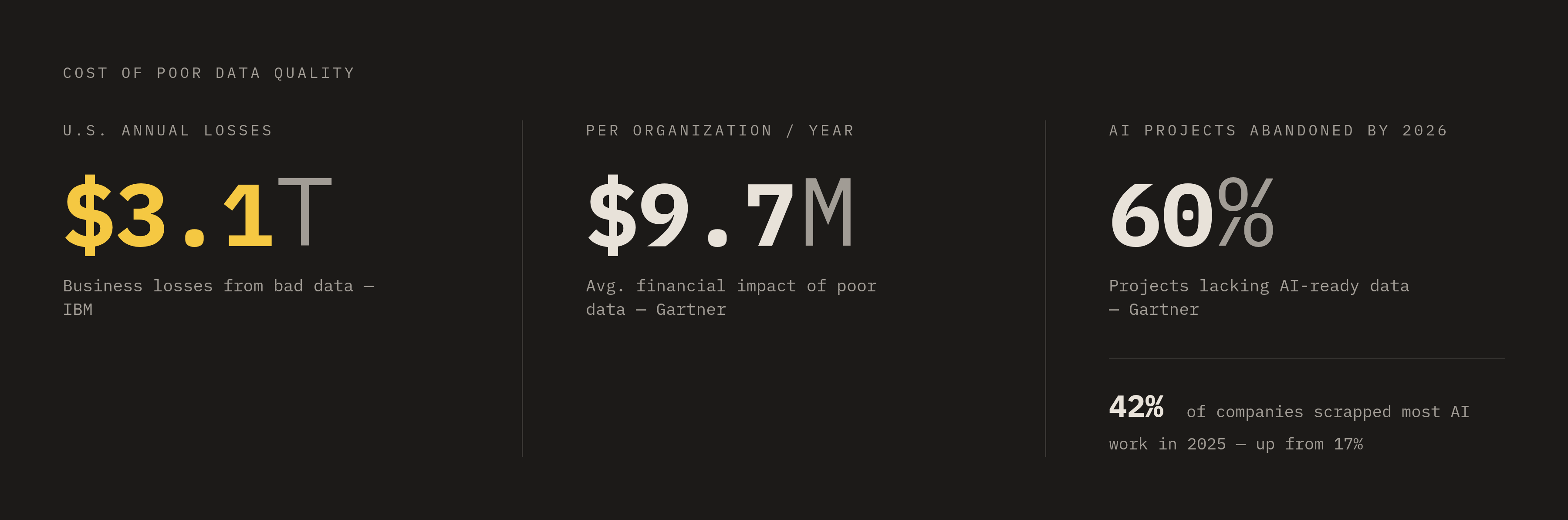
The scale here is not small. IBM research puts US business losses from poor data quality at $3.1 trillion annually, and Gartner separately estimates the average per-organization financial impact at $9.7 million a year. Those are macro numbers, but the enterprise-level detail from IBM's Institute for Business Value makes the pain concrete: 43% of chief operations officers name data quality issues as their single most significant data priority, more than a quarter of organizations estimate losses exceeding $5 million annually from the problem, and 7% report losses of $25 million or more IBM Institute for Business Value.
The downstream consequence is visible in project mortality. Gartner's own forward-looking estimate lands in the same territory: 60% of AI projects unsupported by AI-ready data will be abandoned through 2026. These aren't separate crises. They're the same crisis, measured at different points along the pipeline.
An amplification effect deserves direct attention here. Organizations feeding fragmented, inconsistent data into AI systems don't simply carry their existing data problems forward unchanged. They accelerate those problems at machine speed. A model trained on flawed inputs doesn't just miss its targets occasionally. It actively reinforces the errors baked into its training data, at scale, on every prediction it makes.
Go-to-market functions feel this acutely. Undetected shift means a model's predictions get progressively more wrong, and because that wrongness produces no alarm, teams keep acting on the output anyway, compounding the cost with every decision made on bad information. AI project abandonment stands as a downstream consequence: doubletrack.com research found that 42% of companies scrapped most of their AI initiatives in 2025, up from 17% the year before, as the data foundation wasn't there to support the technology. In go-to-market specifics, Forbes reports that 75% of marketing and sales professionals say bad data slows their teams from reaching goals, while over 80% of submissions in one survey pointed to poor data quality as the source of campaign failures forbes.com.
Mitigation options once shift is confirmed: reweighting, retraining, and data correction
Once shift gets confirmed, the response splits into three categories, and matching the right one to the right shift type is the whole game. When P(X) has shifted but P(Y|X) remains stable, covariate shift, sample reweighting or importance weighting lets a team reweight training samples to better match the production distribution. It's cheaper than a full retrain and often closes most of the performance gap on its own.
When concept drift is confirmed instead, reweighting won't help, because the underlying rule has actually changed. That calls for retraining or adaptation on data collected under the new conditions, and the harder task is curating data that genuinely represents the new distribution rather than just piling on more data drawn from the old one.
When the shift originates inside the data layer itself, stale CRM records, inconsistent field definitions, missing values, fixing the source data becomes a prerequisite step, not an optional one. Retraining on inputs that are still corrupted just embeds the corruption more deeply into the next model.
For teams where retraining is too slow or too expensive to deploy quickly, there's also an inference-time option. GramLoop, described in a 2026 arXiv paper, offers a training-free framework that replays a short transformer window and gates acceptance through cosine-Gram consistency. It improved performance across all five shifted benchmarks tested against a paired baseline on object detection and semantic segmentation, gaining +0.252 mAP and +0.250 Effective Robustness on the COCO-O benchmark, while preserving clean, non-shifted performance. That result matters beyond its specific numbers: it demonstrates that not every response to shift has to run through a full retraining cycle.
The decision itself hinges on a short diagnostic: is the shift in P(X) or P(Y|X), how fast did it appear, and is the underlying data source even trustworthy. Everything covered in the detection sections earlier exists to make that diagnosis possible in the first place. Deliberately widening the training distribution before deployment reduces how much mitigation gets needed down the line, though that only works if a team has some advance sense of which distribution shifts are actually likely, which loops directly back to validation-set design.
How agentic monitoring closes the gap between drift signal and corrective action
Statistical tests, dashboards, and alerts function as early warning systems, and that's a real, valuable function. But they still deposit the actual corrective work onto a human being who has to triage the alert, diagnose the cause, and decide what to do. In practice, alerts tend to fire faster than teams can respond to them; by the time someone triages a data quality issue, the model has often been making degraded predictions for days, sometimes weeks, before anyone acts.
The operational layer of data management has started closing that gap directly. Augmented data management, as it's taken shape through 2026, automates data profiling, anomaly detection, schema mapping, and workflow generation, shifting data teams away from reactive firefighting and toward something closer to proactive governance. That shift matters because it changes what happens between the moment a drift signal fires and the moment someone actually does something about it.
Monitoring answers whether a given metric sits inside an expected range at a given moment, which is distinct from genuine observability. Observability goes further, tracing why that metric moved, tying the anomaly back through the pipeline to its actual source. Agentic systems built on that observability layer close the loop that pure alerting leaves open: they don't just flag that a fraud model's PSI ticked upward or that a CRM revenue field diverged from its finance counterpart. They trace the signal back to its root, in the same continuous stream that already carries traces and evaluation gates for the model in question, and they can act on what they find rather than simply reporting it into a queue for someone to get to eventually. That's the practical difference between knowing a model has drifted and actually keeping it trustworthy while it's still running.