Integrating Eval Harnesses Into CI/CD for ML Model Releases
Blocking eval gates in CI/CD catch model failures before production.
Most enterprises run LLM evaluation outside the delivery pipeline, as something closer to a periodic notebook exercise than an engineering control.
Why eval stays ceremonial
The pattern repeats across the industry in roughly the same shape. The team usually finds out from a customer complaint, not from the eval system that supposedly already checked for this.
The danger isn't that the application crashes. A support agent that tells a customer the wrong return window or misstates a billing term doesn't throw an error. It produces a confident, well-formed, wrong sentence, and a traditional pipeline waves it straight through to production.
Harness AI Evals has documented this exact failure in a simple e-commerce support agent. The build succeeded. The service deployed to QA. The endpoint came up and answered requests. Nothing broke in the conventional sense, and yet the agent's answers weren't good enough to put in front of a customer. The only step in that pipeline built to catch it was a blocking eval gate, and it was the only reason the deploy stopped.
Part of why this keeps happening is organizational. The gap that matters here is simple: an eval running is not the same thing as an eval blocking anything, and that gap is where regressions slip through into production.
What changes when eval blocks instead of reports
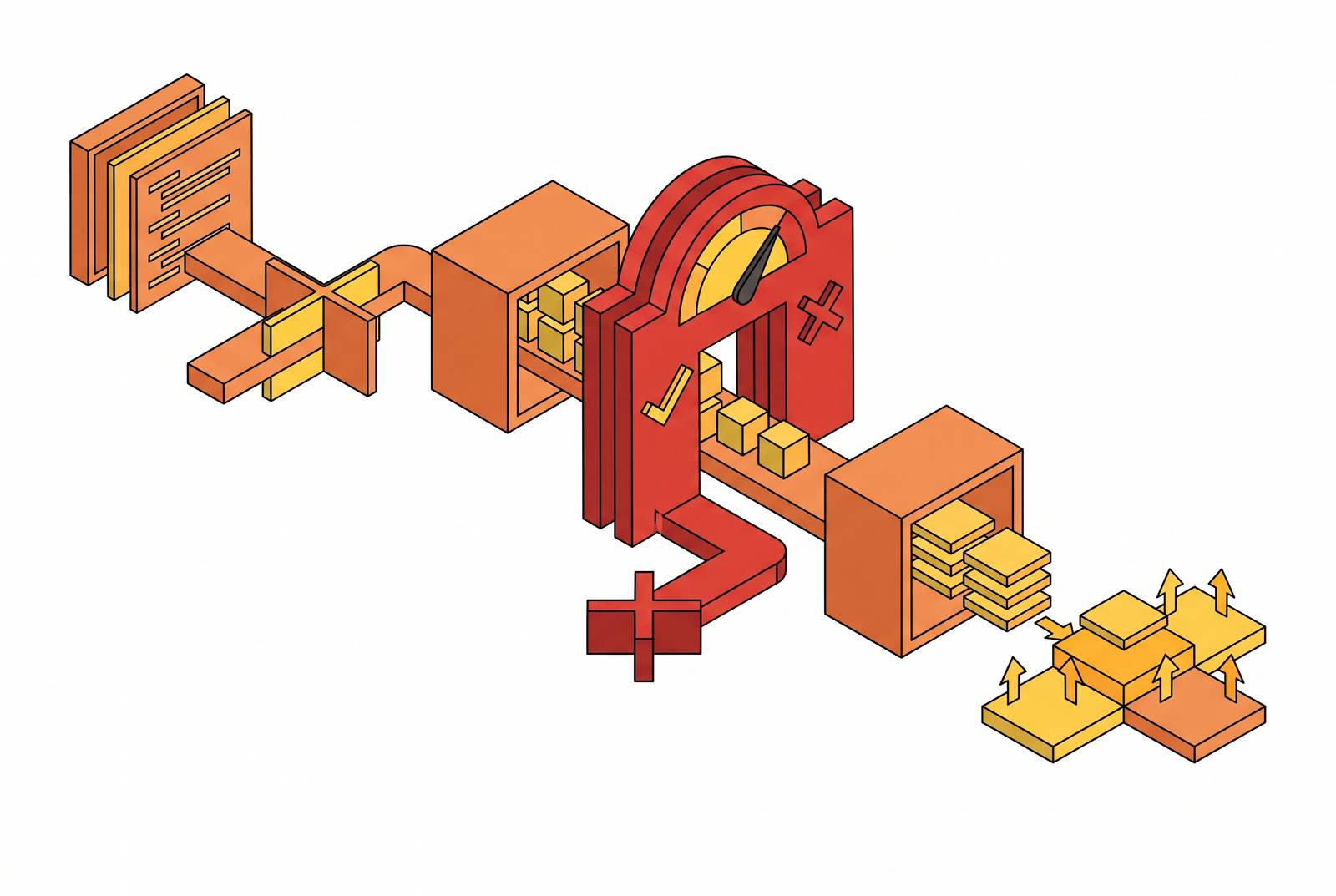
Closing that gap requires a structural change, not a cultural one. Integrating eval into CI/CD means the quality signal produced by the eval and the decision to ship the build become the same decision, made in the same place, by the same system.
Harness AI Evals states this architectural requirement directly: the value comes from running the eval inside the delivery pipeline rather than in a separate tool that reports back later. In a working example, the entire eval-and-gate step completes end to end in roughly seven to eight minutes.
A traditional pipeline asks three questions before it lets code out the door: did it compile, did the tests pass, is the service healthy once it's running. An AI application needs a fourth question answered in the same breath: is this thing behaving well enough to put in front of a real user today. That fourth question doesn't fit inside the first three, because a model can pass all of them and still answer badly.
Harness's 2026 overview of AI deployment frames why this fourth question is hard to isolate. The eval gate is the one mechanism positioned to catch drift across all of those layers at once, because it tests the system's output, not any one internal component in isolation.
The standard objection is that a gate like this slows delivery down. A blocking gate that adds seven or eight minutes to a pipeline is not a bottleneck in any meaningful sense, especially weighed against the alternative. Shipping a model that confidently hands customers incorrect information, and then spending days triaging the resulting support tickets and brand damage, costs far more than eight minutes.
The five artifacts that have to be treated as code before the gate can work
A blocking gate is only as trustworthy as the artifacts that feed it, and five components make up a working eval harness. Each one fails in a specific, predictable way when it's missing or left unversioned.
The eval set is the curated collection of inputs paired with expected behaviors that the model gets tested against. It is stratified deliberately to cover common usage patterns, known edge cases, failures customers have already flagged, and the specific behaviors the system is required to maintain going forward. This set functions as the contract the gate enforces, and a weak or stale one produces a gate that passes things it shouldn't.
The rubric defines, for each input in the eval set, what a correct response actually looks like. Without a documented rubric, two different reviewers score the same output two different ways, and the gate has no stable line to enforce.
The grader is the mechanism that applies the rubric and turns it into a score. Most production harnesses combine more than one type rather than relying on a single grading method for everything.
The alerting and dashboarding layer makes the results visible to the people who need to act on them: engineering, product, and operations. A score that nobody sees doesn't change a decision; it just sits there as a number.
Harness AI Evals provides a concrete picture of what a working eval set looks like in practice: 32 golden support scenarios spanning payments, orders, shipping, returns, cancellations, general support, promotions, and security, scored against Answer Relevancy, Task Completion, and Toxicity. Each of those three metrics tests a different dimension of response quality, which is part of why a single pass/fail score was never going to be enough on its own.
Constructing an eval set that catches behavioral regressions
Of the five components, the eval set has the largest effect on whether the gate catches something real or just produces noise. Three properties decide whether a given set does its job: representativeness, coverage, and maintainability. Missing any one of them stops the set from functioning as a blocking signal.
Representativeness means the set reflects what the model actually encounters once it's live. A set built entirely from synthetic, hand-written prompts tends to pass easily while missing the exact failures users run into, because the people writing the test cases rarely think the way an actual confused customer does.
Coverage means the set exercises every dimension of behavior that matters, not just correctness. That includes high-frequency intents, the edge cases the team already knows about, and the specific failure patterns customers have already complained about. It also has to cover tone, output format, how the model handles requests it should decline, and latency, since a technically correct answer delivered too slowly is still a failure from the user's perspective.
Maintainability means the set keeps evolving through regular additions and revisions after launch. Without that cadence, a set built for one version of the product stops reflecting the product within a few months.
In terms of what the cases themselves should look like, a well-built set mixes happy paths pulled from real usage, recoverable failures, unrecoverable failures, and adversarial inputs designed to probe where the model breaks under pressure.
The eval set is also where the comparison logic lives. A candidate model's raw score on its own tells a team very little. The gate should compare the candidate against the current production baseline on identical tasks, scored by identical graders, and gate the swap on that difference. That comparison needs to include cost and latency alongside quality, since a model that answers slightly better but costs three times as much, or responds twice as slowly, isn't an unambiguous improvement.
Choosing and calibrating graders so the gate does not cry wolf
Grader choice and calibration decide whether a red result means "stop this deploy" or "the judge is broken," and teams that can't tell the two apart eventually stop trusting the gate.
The first rule is to match the grader to the task. LLM-as-judge grading should be reserved for what code genuinely can't score, like tone, coherence across multiple turns of conversation, or open-ended quality where there's no single correct string to match against.
The capability of the evaluator model itself is a variable worth taking seriously. Red Hat's eval-driven development playbook found that a more capable evaluator model produces more accurate evaluations, and listed planning for a capable evaluator model as one of its central recommendations. The judge is a choice that has to be validated on its own terms, not assumed to be reliable simply because it's an LLM doing the grading.
The reliability questions that come up around LLM-as-judge grading are legitimate and deserve a straight answer. The answer to those concerns is rubric discipline and a repeated-run protocol, not abandoning LLM judges in favor of manual review for everything, which doesn't scale.
Two habits keep a gate's results trustworthy once it's running. Trust repetition over a single lucky run: an improvement only counts once it holds up across multiple repeated runs, not after one pass. Or it can mean the judge model or the target endpoint had an infrastructure problem, which is a different kind of issue entirely and shouldn't be scored as a quality failure.
The real threat to a gate's integrity is false-positive fatigue. Calibration is the ongoing work that keeps a red result meaning something.
Wiring the gate into the pipeline
A production-grade gate needs tiered execution: cheap deterministic checks run on every single commit, while the more expensive LLM-scored evals run before a merge or on a nightly schedule.
Tier 1 runs on every commit and covers deterministic tests: exact-match comparisons, schema validation, checks that tool calls are structured correctly. These run in under a second, make no API calls, and cost nothing to run. They can run constantly without anyone thinking twice about it. They catch structural regressions the moment they're introduced.
Tier 2 runs before a merge or on a nightly schedule and covers LLM-as-judge scoring against the golden dataset. This is where metrics like Answer Relevancy and Task Completion, along with the behavioral rubrics built earlier, actually get applied. These checks cost more to run than Tier 1, so they're scheduled on a cadence that keeps that cost under control.
The cost logic behind that split is straightforward: there's no reason to pay a frontier model to confirm a tool call schema hasn't changed when a schema assertion answers that question for free and instantly. In the working example from Harness AI Evals, the complete eval-and-gate step, start to finish, runs in roughly seven to eight minutes inside the pipeline.
There's a shortcut available at every one of these gates, and it's tempting precisely because it's easy: lower the threshold until the gate turns green. The only honest path when a gate keeps failing is to fix the application, not to adjust the bar it has to clear.
What a red gate tells you
When a gate fires red, the value of everything built up to that point either gets realized or thrown away, depending on how the team responds. Two distinct things can cause that red result, and they call for completely different reactions.
The second is an infrastructure or judge failure: the evaluator model is down, the grader is misconfigured, or the endpoint being tested isn't responding. This isn't a quality signal at all, and treating it like one confuses the team about what actually needs fixing. It should be handled as an infrastructure incident, separately from any question about the model's behavior.
A well-built gate stops a bad deploy and tells the team what's wrong. In one real e-commerce agent, Harness AI Evals traced five of eight recurring failures directly to incorrect, missing, or incomplete knowledge: wrong payment and billing facts, missing details on cancellations and customer service, incomplete shipping information, inconsistent answers about gift cards, and indirect responses to questions that needed a plain yes or no. Failed cases turn that vague instinct into a specific, actionable list of what to fix next.
Non-determinism complicates this picture without undermining it. The right response is to trust repetition: run the case several times before concluding a result reflects a genuine regression, and treat a failure that holds up consistently as the real signal, not a one-off fluke. If the agent's answers vary meaningfully across runs on the same input, that instability is itself a real quality problem, not something to average away and ignore.
None of this works if the threshold gets moved every time it's inconvenient. Lowering the bar to clear a failing gate is how a blocking gate quietly turns back into the ceremony this whole approach was built to replace. The threshold represents the engineering team's actual commitment to a quality bar, and adjusting it in response to a failure is an admission that the bar was never real to begin with.
Why upstream data quality determines whether the gate can be trusted
Everything above assumes the gate's inputs are sound, and that assumption only holds if the data behind the model is itself reliable. Harness's 2026 overview of AI deployment identifies the data and embeddings layer as its own distinct component of the stack, one that can independently degrade the entire application regardless of how well the model or the prompts are performing. That's a first-class deployment risk, not a background concern to revisit later.
The failure appears concretely in go-to-market and RevOps contexts. AI-powered lead scoring models train on historical CRM data, and if that data contains misclassified accounts and phantom opportunities, the model learns patterns from records that were wrong to begin with. An eval gate cannot catch this if the golden dataset used to test the model was built from that same dirty source; the gate would simply confirm the model agrees with bad data.
AI SDR tools that draft outreach based on CRM contact fields run into the same problem from a different angle.
Agentic systems raise the stakes further. As these agents start taking actions directly inside systems of record, the quality of the data they read and write decides whether their decisions compound correctly over time or compound errors instead.
The practical implication for gate design is that golden datasets need to be audited for data quality, not just for behavioral coverage. A dataset built from records with missing fields, stale job titles, or duplicate accounts produces a gate that passes models behaving badly on inputs that look perfectly realistic. Because data decay is continuous, automated detection of duplicates, missing fields, and inconsistencies across the systems of record an AI application depends on has to run constantly, applied in place of periodic manual cleanup. That ongoing discipline keeps the eval gate's signals meaning what they're supposed to mean even as the data environment it relies on keeps changing.