The Acquisition Playbook for Rolling Multiple Salesforce Orgs Into a Single Instance
Consolidating Salesforce orgs requires mastering data quality before moving records, not after.
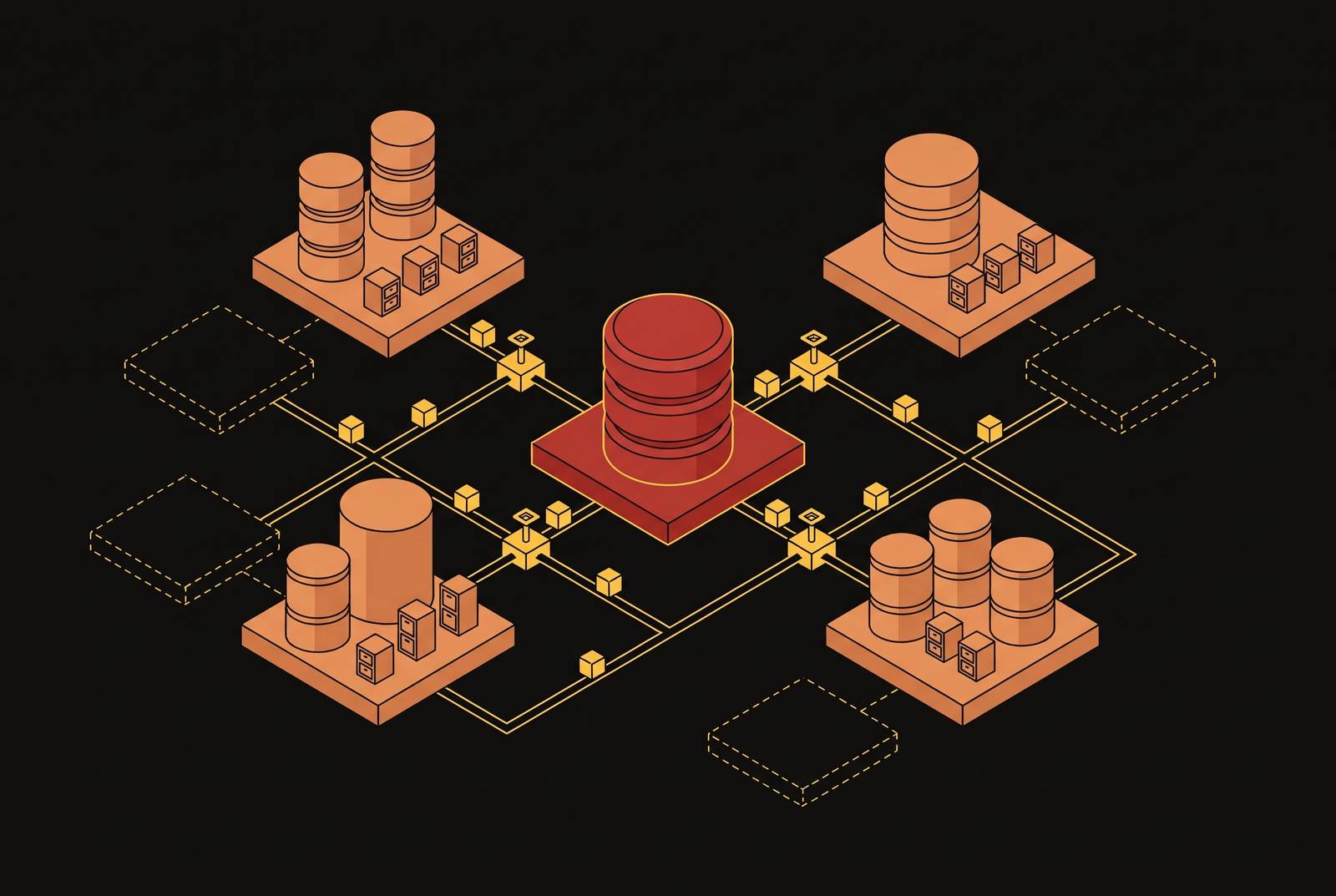
CRM data quality for M&A integration depends on four sequential phases, which are assessment, data reconciliation, migration, and governance. Consolidating Salesforce orgs succeeds when teams resolve customer definitions, duplicates, and conflicting field values before migration. The acquisition playbook is therefore a data quality discipline first and a record-moving exercise second.
Why multi-org Salesforce environments become a liability after an acquisition
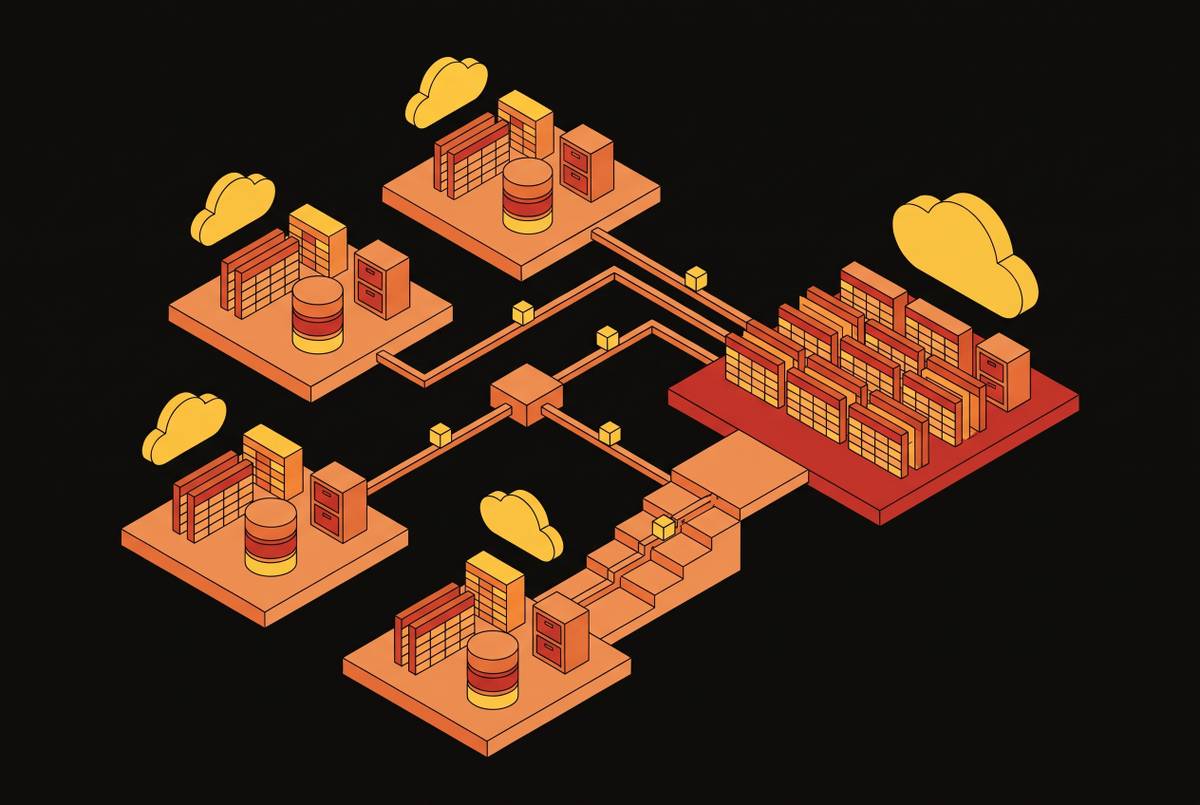
On day one after close, a RevOps leader can inherit two sales teams calling the same account without visibility into each other’s activity. Service history remains divided between environments. Leaders have no single view of the customers they share, their cross-sell opportunities, or their total pipeline. The acquisition has combined the businesses, but not their operating records.
The administrative burden compounds that commercial fragmentation. Two admin teams maintain two release cycles and two sets of licensing, while middleware, ETL jobs, and point-to-point connections multiply to bridge gaps. Each patch adds another connection to manage. Keeping separate orgs can be a deliberate architectural choice, but leaving them disconnected is not a sustainable integration strategy. Clean, unified data for each target use case is also a prerequisite for reliable AI agents, making unresolved fragmentation a constraint on deployment as well as reporting.
The cost of delay: what bad CRM data does to revenue before consolidation is complete
Poor CRM data imposes costs before consolidation finishes. Duplicate outreach wastes effort, missed handoffs create revenue leakage, and attribution blind spots make spending harder to evaluate. Those costs accumulate while teams debate the destination architecture. A slow project leaves the operating problem intact, but a rushed migration that preserves bad data merely transfers it to the surviving org.
For PE-backed firms, unreliable metrics also weaken board confidence and delay strategic decisions. Due diligence can lead to a lower valuation when NRR, CAC, and pipeline velocity cannot be verified. The exposure extends beyond the integration budget. Companies have halted valuable initiatives because their CRM data was not dependable enough to support them. Front-loading data quality work enables consolidation to remove this obstacle.
The first decision: merge into one org, stay multi-org, or build greenfield
Before any record moves, the team must decide whether the combined business needs one org at all. A full merge fits businesses that share many of their processes and plan to sell, service, and report as one entity. The case is stronger when the businesses share many customers and have cross-sell goals. By contrast, governed multi-org keeps environments separate by design, with shared reporting, integration, and governance. It suits genuinely different geographies, regulatory requirements, or business models.
A greenfield rebuild moves both legacy environments into a new org built for them. It is typically the slowest and riskiest path. Conflicting data models and extensive customization in both orgs may justify it, but the approach belongs primarily to environments that are beyond repair. The decision should turn on process overlap, customer overlap, model compatibility, regulation, and technical complexity. The size of an org and who the acquirer is do not establish which architecture will work.
The Clari-Salesloft combination illustrates the distance between announcing a transaction and reconciling its underlying products and data models. Forrester described the integration as a “lengthy, iterative process.” The announcement is not the integration plan. Within a full merge, lift and shift minimizes time to cutover but inherits duplicate fields and technical debt, making it appropriate only when speed is paramount, such as a compliance deadline. Optimized consolidation is the recommended approach because it standardizes processes, retires redundant objects and automation, and resolves performance hotspots during the merge.
Phase one: assessing both orgs before a single record moves
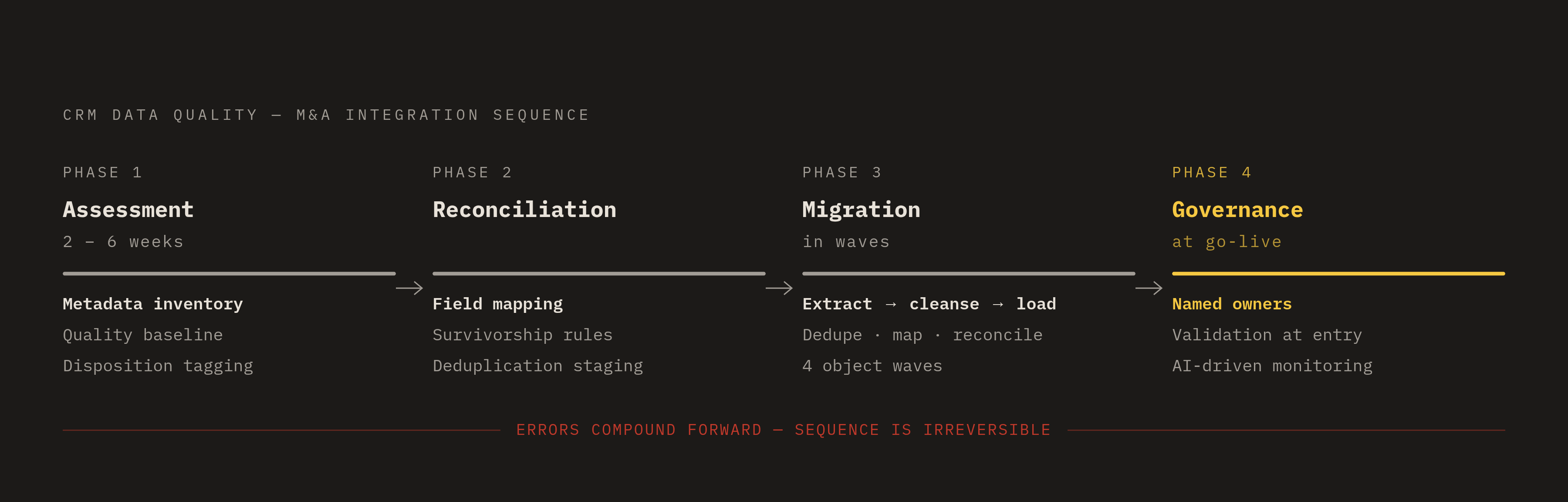
Assessment should produce a complete side-by-side inventory, typically through a two-to-six-week exercise. The metadata inventory must cover objects, fields, page layouts, record types, validation rules, flows, triggers, Apex classes, sharing rules, and permission sets. Data assessment also covers how much data each object holds, who owns it, and its key relationships. The integration map covers upstream and downstream flows, ETL jobs, APIs, middleware, the event bus, and external apps. The data quality baseline is equally essential. It must show how the data measures up on completeness, duplicate rate, field accuracy, and historical record integrity.
Documentation alone will not expose every dependency. Managed packages, integrations, and automation chains that are missing from standard documentation often cause projects to run late. Girikon specifies that assessment must also compare security, reports, packages, and historical records across the environments. Each inventoried asset should receive a disposition of Keep, Replace, Merge, Retire, or Rebuild. That status should depend on the asset’s business value and the technical need for it, regardless of which org it came from.
The same principle applies to target selection. The stronger destination has scalable architecture, higher-quality data, better governance, and less technical complexity, even if it belongs to the acquired company. Choosing the acquirer’s weaker org embeds a disadvantage in every subsequent phase. Before scope is set, stakeholders should agree on success criteria such as unified reporting, license rationalization, compliance, and performance, together with non-negotiables covering zero data loss, the downtime SLA, and data residency. Altimetrik recommends an “org merge charter” or “governance manifesto” to anchor these decisions.
Phase two: how to deduplicate customer records and reconcile data models before migration
Deduplicating customer records starts with agreeing on what those records represent. An account may mean a legal entity in one org and a household or buying location in the other. That distinction must be resolved before selecting or running migration tooling. Field mapping, survivorship rules, and reporting all depend on the combined business agreeing on the unit it intends to manage.
The target model should then systematize fields and preserve only essential custom fields. Picklist values, field types, and naming conventions need normalization across both environments before records are compared and mapped. Ownership rules must preserve historical ownership information as well as define responsibility in the target. Authority should be assigned by data domain. The system of record for accounts, contacts, and opportunities need not be the same org, so choosing a surviving environment does not automatically decide which source values win.
Field-level survivorship rules must specify which value prevails when records conflict, and why, for each object. Email, domain, and normalized name provide match keys for deduplication, but the agreed entity definition determines what constitutes a duplicate. These decisions belong in the migration workbook. It should capture source and target objects and fields, transformation logic, mandatory fields, external IDs, defaults, ownership, and validation requirements. Legacy record IDs must also be kept through migration so records can still be traced and audit trails stay intact, with no historical records left orphaned.
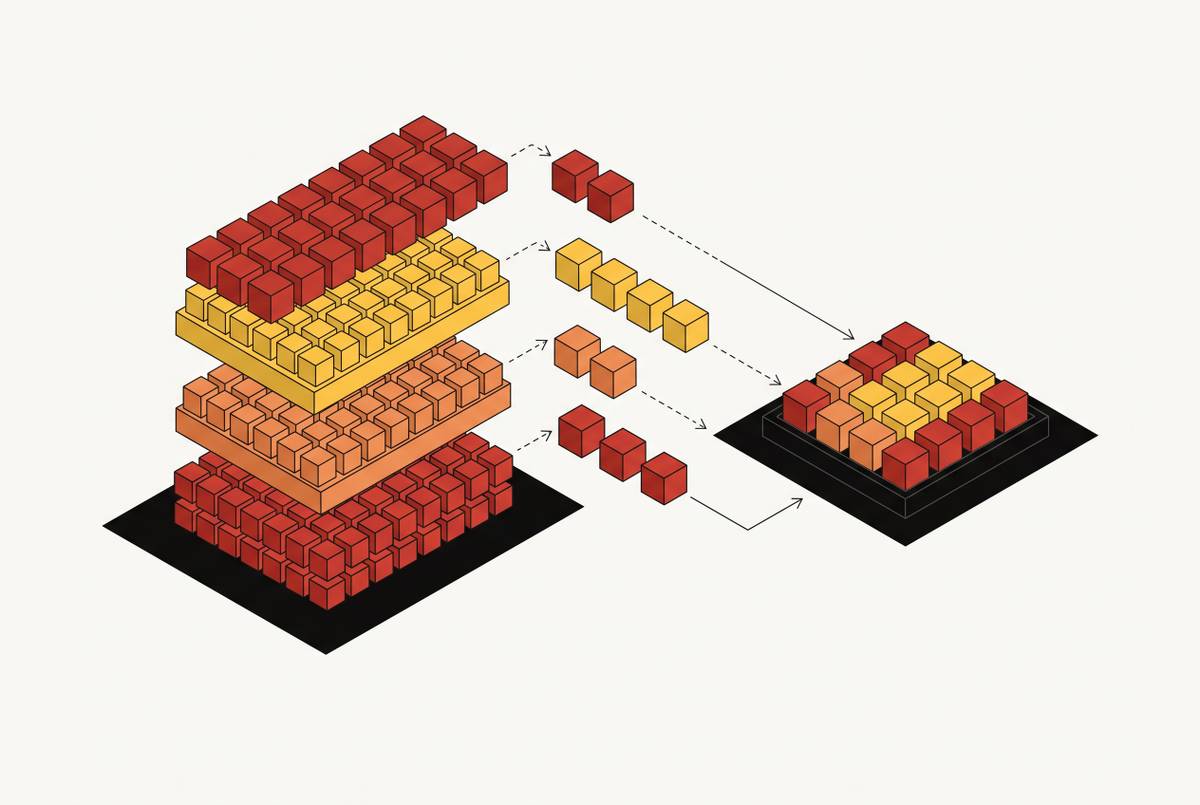
Deduplication should run in staging before loading. Post-migration deduplication is more expensive and disruptive. Agentic data quality tools fit this phase because they can continuously scan both orgs for duplicates, missing fields, and field-level inconsistencies, then propose or apply fixes before records migrate. Their value comes from addressing defects where correction is cheapest. The workbook and target model remain the contract those corrections and the migration must follow.
Phase three: migrating data in waves without breaking revenue operations
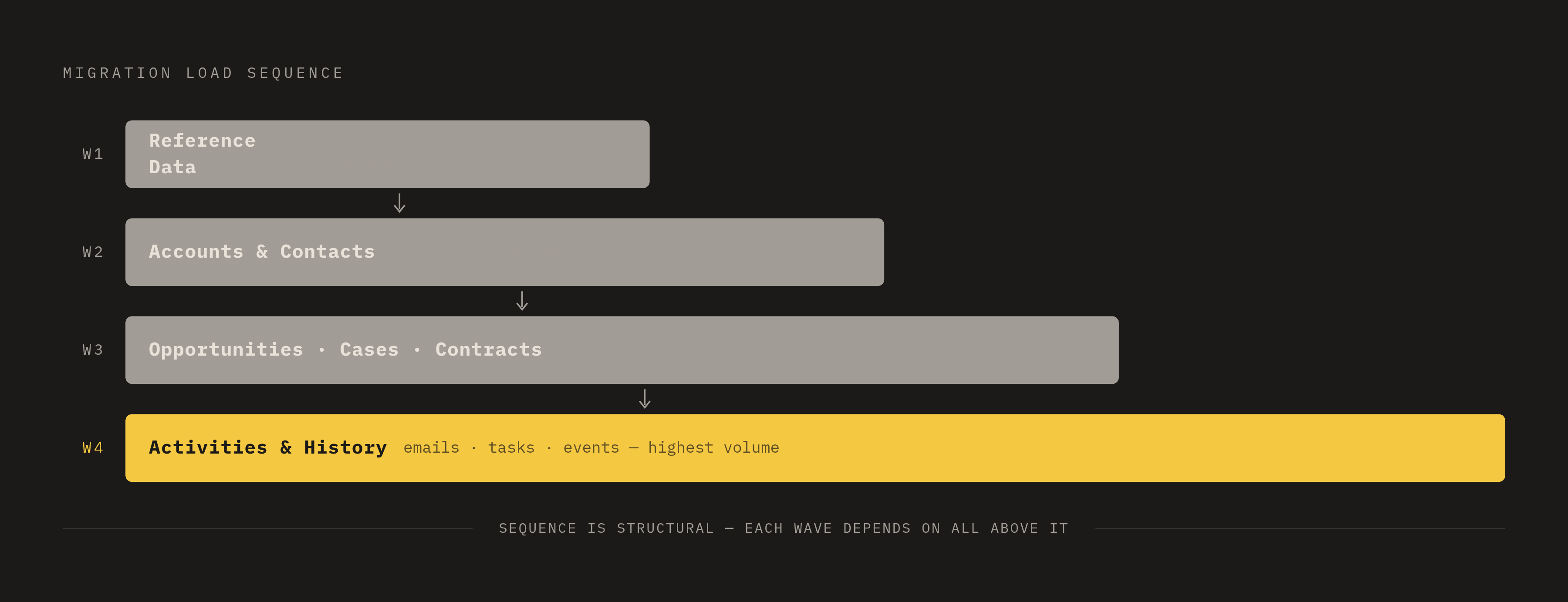
The execution sequence should be extract, cleanse, dedupe, map, load, and reconcile. Each stage has a distinct job. Cleansing and deduplication get records ready for the agreed model, while reconciliation checks what the load produced. Skipping or collapsing stages trades a faster cutover for later cleanup. The production migration should execute the reconciliation decisions already made, rather than become the setting in which teams first debate them.
Object dependencies determine the order of the waves. Wave one establishes reference data, including picklists, record types, and custom objects without dependencies. Wave two loads accounts and contacts, which provide the foundations for related records. Wave three follows with opportunities, cases, and contracts. Wave four brings activities and history, including emails, tasks, and events, which have the highest volume but the lowest structural risk. Loading records before the records they depend on breaks relationships and leaves orphaned records.
Record-count validation is required after every wave. It catches data loss or corruption before the problem propagates into the next load. Sandbox dry runs should refine reconciliation steps and expose integration failures that the inventory missed, without risking production operations. Code freeze windows, rollback plans, and downtime SLAs must be agreed in advance. Cutover is the wrong moment to negotiate them.
Automation also needs a future-state design. Flows and triggers often encode obsolete or org-specific processes, making their unmodified migration a leading cause of post-merge record-save errors. Redundant automation should therefore be retired during optimized consolidation. The same logic applies to integration architecture. Where possible, rebuilding around versioned APIs or event-driven, idempotent endpoints avoids recreating the point-to-point sprawl that the project was intended to remove.
The contract sequencing mistake that inflates costs during consolidation
Licensing consolidation creates a negotiating opportunity that technical planning can inadvertently surrender. That leverage is available only once. Disclosing the combined footprint before negotiations begin gives the vendor information that can weaken the buyer’s position and inflate costs. CIOs and RevOps leaders should therefore plan renewals around consolidation milestones before they talk to a vendor about org counts or the combined number of users. The commercial sequence needs to be settled before technical disclosure makes the decision for them.
Phase four: governance structures that prevent the consolidated org from degrading
Governance must be in place at go-live. Account, contact, and opportunity data must each have a named owner who is accountable for it. Validation belongs at the point of entry. Field-level rules should prevent invalid inputs rather than leave them for later batch cleanup, while change management should require review of new custom fields, objects, and automations against the unified model. Without that review, the model reconciled before migration can begin fragmenting again through ordinary changes.
Duplicate monitoring must continue after the migration ends. Integrations, imports, and manual entry keep adding records, so a clean staging dataset does not ensure that the production org will stay clean over time. AI-driven monitoring can watch for stale data, duplicates, missing required fields, and field-level inconsistencies, then propose or apply fixes. That changes the economics of ongoing control. It can operationalize governance without requiring dedicated headcount for every domain, while defined owners retain accountability for the data.
For serial acquirers, each new deal tests whether that governance can absorb another org without allowing data quality to decline again. A one-time cleanup leaves the business exposed to the same degradation cycle at every acquisition. Continuous governance creates a different starting point. Teams that keep data quality high through accountable ownership, entry controls, and AI-assisted monitoring keep a foundation they can use to deploy reliable AI for defined use cases. Teams that stop at cutover will have to repair that foundation again before either the next acquisition or the next AI initiative can depend on it.