Root-Causing Hallucinations to Training Data Gaps
Training data gaps, not model architecture, drive AI hallucinations.
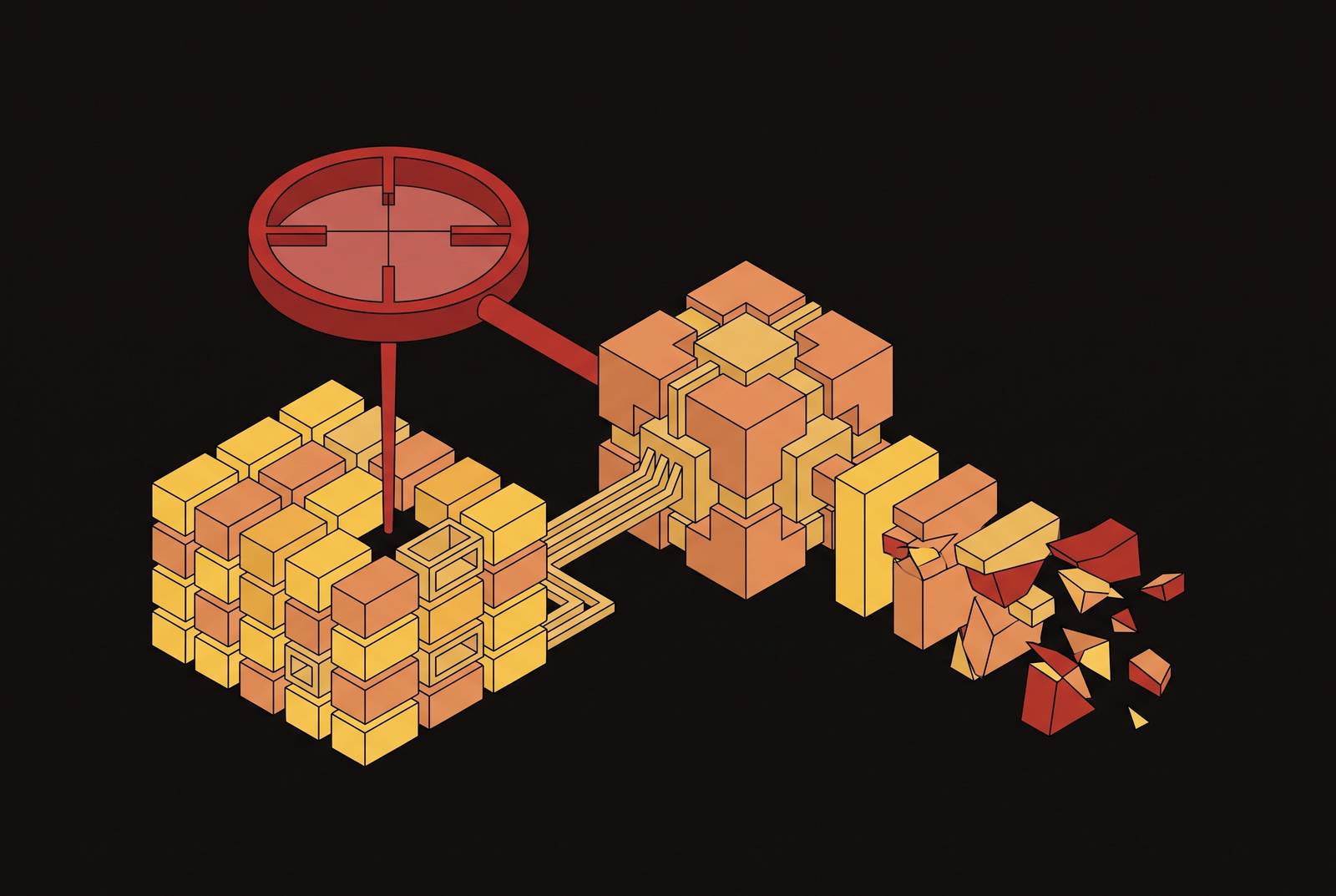
AI hallucinations are most productively investigated as data failures. Sparse coverage, inaccurate or conflicting records, and stale facts can leave a model without reliable grounding. Tracing those gaps back to enterprise systems of record gives practitioners a concrete way to improve reliability at its source and reduce reliance on repeated output corrections.
Why "model failure" is the wrong frame for AI hallucinations
An architecture-centric explanation places the remedy inside the model. It directs attention toward training objectives, sampling changes, and fine-tuning, which are often opaque or inaccessible to enterprises deploying AI. Those mechanisms matter, but they do not account for the quality of the information the model learns. Treating every hallucination as an architecture bug can thus hide a cause the enterprise can control.
A data-centric explanation changes the investigation from how the model generated an answer to what evidence was available to support it. The relevant questions concern completeness, consistency, accuracy, and maintenance. It means that data gaps are a genuine causal factor and, where they are the root cause, enterprises can act on them.
How training data gaps mechanically produce hallucinations
The causal chain begins with sparse coverage. A fact that appears frequently and consistently in training data gives the model a stronger pattern to draw on than one represented thinly or not at all. When that grounding is absent, the model can extrapolate from unrelated content instead. The resulting answer may resemble a well-supported answer in its language while lacking the evidence needed to make it correct.
The training objective compounds this gap because fluent, statistically likely output is not the same as factual accuracy. A model optimized to produce likely text does not necessarily express uncertainty when its knowledge is incomplete. It can therefore face two conditions at once, namely no grounded answer to give and an objective that favors completing the response. Token-by-token sampling then selects a plausible continuation without making plausibility a guarantee of truth.
Conflicting data can cause a similar problem even when there is plenty of coverage. Repeated exposure to incompatible records about the same fact does not provide a consistent factual signal. Instead, the model learns from competing patterns, making its representation unreliable despite the volume of material available.
The MIT/Harvard Medical School study illustrates the limits of specialization without adequate grounding. It found that hallucination-free response rates were lower for medical-specialized models than for general-purpose models, with a gap of 25.2 percentage points. Their explicit domain optimization did not compensate for narrower and potentially inconsistent coverage. The finding supports a distinction between training on relevant subject matter and training on material with sufficient breadth and consistency.
The three data failure modes enterprises need to distinguish
Sparse coverage is the first failure mode, in which a fact or entity appears too rarely for the model to form a reliable representation. In enterprise systems of record, coverage may be missing for a given account type, product category, or deal structure. The model then fills the gap through extrapolation in the absence of grounded recall. Correcting the records that exist cannot supply information that is absent.
Factual inaccuracy is the second failure mode, in which the data contains wrong or contradictory records. In CRM and RevOps systems, these include inflated pipeline stages, misclassified accounts, and duplicate records with conflicting attributes. Unlike sparse coverage, this failure supplies a signal, but the signal itself is wrong. A model can learn that error as a pattern and keep producing outputs skewed in the same way, turning the error into more than an occasional mistake. The remediation must therefore correct or remove inaccurate records and resolve conflicts.
Temporal staleness is the third failure mode, in which information was accurate when collected but no longer describes the business. B2B contact and account data decays, while a model trained on a snapshot can treat old records as current fact. Historical Salesforce data with stale close dates, phantom opportunities, or deprecated products can embed distortions in forecasts and scoring. This differs from an originally false record because the missing property is freshness. The remedy requires controls that maintain currency as well as accuracy at collection time.
Why these failures are invisible until they damage business outcomes
Missing, conflicting, or outdated grounding can still produce a confident answer with no visible warning in its wording. The Air Canada chatbot case illustrates the gap between apparent authority and correctness. The chatbot misrepresented bereavement fare policy, and the B.C. Civil Resolution Tribunal held the airline liable. One wrong answer put the airline at legal risk and risked its reputation, even though it looked like ordinary advice to a customer.
The Morgan & Morgan filing shows the same gap at a different point of consequence. It contained fictitious case citations generated by AI, and the failure reached a court before sanctions followed. In both cases, an external reality check exposed an error that the output’s fluency did not reveal. These incidents demonstrate the danger of treating convincing language as evidence. They do not, by themselves, establish which training records or retrieval inputs caused the failures.
That distinction matters because an incident identifies the harm before it necessarily identifies the cause. A made-up citation shows that grounding failed, but finding out why still requires looking at the data behind it. A misrepresented policy similarly calls for distinguishing missing information from conflicting or outdated information. Without that investigation, an organization can correct an answer while leaving the condition that produced it intact.
Restoring trust after a data-quality-driven AI failure can involve paused programs, switched vendors, expanded governance teams, and delays to the next initiative. Those steps add to the original loss because they affect how willing and able the organization is to deploy AI. If fluency conceals failure until an external consequence exposes it, output correction alone arrives too late. Prevention has to reach upstream into the data on which the system depends.
Why fixing data at inference time — RAG and guardrails — doesn't close the gap
Retrieval-Augmented Generation can help when a model's training has left gaps in its knowledge. It brings information into the answer process at query time, reducing reliance on what the model learned during training. Guardrails add necessary controls through structured output, calibrated refusal, and consistency checks. These measures reduce exposure and belong in the reliability stack. Their value does not, however, make the quality of the underlying data optional.
Retrieval changes when evidence becomes available, but it does not make inaccurate evidence true. If retrieved records are contradictory or stale, the grounding available at inference time remains defective. RAG also leaves in place distorted patterns the model learned during training. The distinction is between supplying additional information and establishing that the information is fit to support the claim.
Consistency checks can detect some conflicts, while external fact-checking and uncertainty calibration can reduce the risk of unsupported answers reaching users. They do not prevent inaccurate patterns from entering training in the first place. A structured response format also gives no assurance that the facts in its fields are correct.
The MIT/Harvard Medical School study found that medical-specialized models had a median hallucination-free response rate of only 51.3%. That result concerns domain specialization rather than a direct test of every RAG or guardrail design. Its relevance is that narrow optimization did not itself produce reliable factual performance. Enterprises therefore need both downstream mitigation and upstream prevention. Otherwise, each new deployment extends the area in which unresolved data defects can cause failures in generated outputs, leaving teams to chase failures after generation.
What a structural fix actually requires — continuous data quality in systems of record
A structural fix begins with the fact that enterprise data quality changes over time. Records decay, new inaccuracies enter, and coverage thins as the business evolves. A pre-deployment cleanup can improve a snapshot without maintaining the conditions that made it reliable. Continuous data quality is therefore not an additional finishing step. It is the ongoing work required to keep training and retrieval inputs grounded as their sources change.
Bad data needs to be caught before it enters those pipelines. Detecting and correcting a conflicting account record before it is used is different from alerting after the model has already learned from it. An alert raised after retraining may reveal the source defect, but it has not prevented that defect from influencing training. Proactive control addresses the input. Retrospective alerting identifies exposure after the opportunity for prevention has passed.
Governance by design places data quality, lineage tracking, and consistency controls inside the architecture from the start. Lineage provides the basis for tracing an output problem back toward the records that could explain it. Consistency controls deal with versions of the same fact that disagree, while quality controls cover information that is missing, wrong, or stale. Together, these capabilities make source defects observable before a business outcome becomes the first warning.
Agentic approaches address the delay between detection and correction by continuously monitoring data, detecting anomalies, proposing fixes, and applying them autonomously. Their structural advantage over alert-only approaches is that they do not depend on human triage at every step. In a manual sequence, corrupted data may reach retraining or production retrieval while an alert is still waiting for review. The aim is therefore not simply faster notification, but intervention at the pace at which the underlying records change.
For revenue and go-to-market AI, CRMs and RevOps platforms are central to this work. They feed lead scoring, forecasting, and engagement AI directly, while carrying chronic quality problems at the field and record level. Conventional monitoring can miss the specific conflicts and omissions that matter to those applications. Keeping these systems of record in good shape is therefore administrative work that also helps keep AI reliable.
A practical framework for tracing a hallucination back to its data source
The first step is to classify the observed failure before choosing a remedy. Classify the claim as fabricated if grounding is absent, contradictory if available grounding conflicts, or outdated if the relevant fact has changed. A reasoning error and an inaccurate source record can both produce a wrong answer, but they call for different interventions. The purpose is to narrow the investigation without assuming that every incorrect output has the same origin.
The second step is to trace the claim to the training or retrieval data that corresponds to it. In a CRM or RevOps application, this means inspecting the relevant account, contact, or opportunity records. The inspection should look for missing fields, duplicate conflicts, inconsistent stage histories, and stale contact data. It should distinguish information that was never available from information that was present but corrupt or obsolete. That distinction links the visible symptom to a specific data failure mode.
The third step is to apply the upstream correction that matches the evidence. Add coverage where the necessary facts are sparse, correct or remove inaccurate records, and establish freshness controls where staleness caused the failure. A one-time cleanup restores quality only momentarily if the same degradation is allowed to resume. Continuous monitoring and correction make the intervention durable.
Over time, this diagnostic practice becomes an organizational capability rather than a sequence of isolated incident responses. Teams gain a repeatable way to connect an unreliable output with the data condition that produced it and the control needed to prevent recurrence. That capability supports continuous improvement instead of waiting for another business consequence to reveal the next defect. Its foundation is clean, observable data in the systems of record on which enterprise AI depends.