Silent Data Losses During Salesforce Migration That Poison Your AI Training Set Before You Notice
Corrupted Salesforce migrations can silently poison AI training data before detection.

Salesforce migrations can poison AI training sets without producing an obvious failure. Orphaned relationships, altered field values, missing histories, and cutover gaps can pass go-live checks and be accepted as training data. Protecting that data requires more than a successful load or a pre-migration scrub. It requires continuous checks on the records, relationships, and history that AI systems consume.
Why Salesforce migrations silently corrupt AI training data rather than failing visibly
A migration crash is loud, immediate, and fixable. Silent loss can accumulate undetected until the source needed to repair it is no longer available. The distinction is between a load that stops and a load that finishes with its meaning damaged. In the second case, the target can still work while giving downstream systems only part of the picture of customers, deals, and engagement.
Record counts and go-live stability measure only part of success. Neither establishes that a Contact still belongs to the correct Account, that a populated field retains its original value, or that an activity remains linked to the record it describes. A migration can therefore pass those checks without preserving the structure AI needs. The validation process accepts the rows, but not necessarily their meaning.
That gap becomes consequential when the target becomes a training source. A model has no inherent way to distinguish an intentional blank from a failed mapping or a genuine category from a forced default. Those values become evidence. Rather than averaging the errors away, AI can learn the distorted patterns and produce confident forecasts or recommendations from them.
How the mechanics of a Salesforce migration create structural gaps before a single record is flagged as failed
Silent orphaning begins when a child object loads before its parent exists in the target org. Lookup failures can leave records without parent relationships or drop rows in ways that summary counts do not clearly show. Load order is therefore a dependency. The standard sequence is Accounts, then Contacts, then Opportunities, then Cases, then Activities. A break in that sequence can propagate through dependent objects.
Field mappings introduce a separate failure path. Date formats, picklist values, currency codes, and field types can differ between source and target, causing rejected rows or truncated values that still look populated. A source value of “United States” may not match a target picklist entry of “USA”. A null or default can replace the intended value. The field then appears valid without preserving the source information.
Activity migration depends on both records and links. Salesforce’s official Help article establishes that Data Loader supports importing Tasks and Events with WHOID and WHATID fields to maintain their relationships. Flattening is not an unavoidable import behavior. The migration must map WhoId and WhatId to valid destination record IDs, while Opportunity Stage History requires separate exports from OpportunityHistory and OpportunityFieldHistory. Activity extraction is also rate-limited, so millions of activity records can require more effort than larger account or contact populations.
Cutover introduces the fourth mechanism through timing. Records created or updated in the source during the migration window are absent from the initial load unless the delta is captured. Counts from the initial load do not show that later gap. Longer migration windows accumulate larger deltas, including when higher record volumes extend the work.
Why these mechanisms compound rather than stay isolated when data quality is already degraded at the source
Duplicate Accounts, blank fields, and inconsistent formats already make it hard to tell which records belong together and what their values mean. Migration adds another layer of ambiguity to them. A team can resolve a field mapping correctly while still transferring competing identities, or preserve a row while losing the relationship needed to interpret it.
Duplicate Accounts show how those failures become entangled. Loading both creates competing parents in the target, and a Contact or Opportunity can resolve to the wrong one. The lookup may exist, yet the business relationship is wrong. Correcting that assignment after loading can require untangling it from other records whose relationships now depend on the same duplicated structure.
Missing source relationships create a related problem without any failed lookup. A Contact with a null AccountId can arrive without a parent because it had none to transfer. That is inherited damage. Yet the destination now presents it beside newly orphaned Contacts, and both can distort the firmographic features used to qualify contacts.
The resulting cleanup extends beyond the imported dataset. Once workflows, automations, and reports consume the damaged records, remediation must account for those dependencies as well. Fixing a source relationship before loading is materially different from changing it after the destination has accumulated new engagement history.
What happens to AI systems when they train on this class of corrupted CRM data
Orphaned records break the entity resolution that account-level models need. When a Contact loses its link to its Account, models cannot reliably use it for account risk, account-based forecasts, or next-best-action recommendations. The missing relationship changes the model’s view of the entity. It treats the Contact differently from Contacts that are otherwise much the same but still have their parent relationships.
Forecasting and propensity models use the sequence and timing of sales activity, including calls before close and email cadence relative to stage progression. Flat notes without WhoId and WhatId linkages cannot preserve that relational context. Missing OpportunityHistory and OpportunityFieldHistory exports also remove the stage-progression timing needed to interpret the sales sequence. Restoring that history then depends on what source material is still on hand.
Truncation and defaults can bias features without leaving blanks. If a null Industry field is force-filled with “Technology” to pass validation, training treats that entry as a genuine category assignment. The default becomes part of the learned distribution. Truncated values also leave the model with populated fields that no longer hold what was in the source.
Delta gaps distort the training set through omission. The most recent pre-cutover deals can be missing precisely because sales representatives updated them during the migration window. The model receives stale coverage with nonrandom omissions. Salesforce’s data and analytics trends report frames data quality as a prerequisite for AI strategy, which fits this failure pattern. The problem begins in the evidence available to the model, before a forecast or recommendation is produced.
The production cases that show how silently losses surface — and how late
In the manufacturing-company example in the supplied evidence, field mapping errors made deals show zero value and had to be fixed by hand. The visible symptom was a value. The account supports the migration failure mechanism, but it does not establish that an AI system trained on those records or provide a measured downstream AI outcome.
The evidence does not give a full account of two production cases. In particular, it does not provide enough case detail to establish that both passed go-live counts or were discovered through report anomalies. Those limits are important to the argument. The recorded mapping failure shows why field-level validation is needed, but it does not prove every proposed way that a migration error could harm AI.
Validation must cover accuracy, completeness, and the functioning of automations, workflows, and reports because a stable application can still operate on damaged data. Finding the damage costs more once those dependencies are in place. By the time users notice missing records or incorrect histories, rollback may no longer be realistic, and retired source material can make clean reconstruction impossible.
Why pre-migration data scrubs alone do not solve the problem — and what the objection reveals about where the real fix must live
Cleaning the source first is a sound objection to avoidable migration damage. Deduplication, complete fields, and consistent formatting reduce the defects that loading can amplify. That work should not be dismissed as temporary housekeeping. Moving dirty data instead can stretch cleanup from weeks to months, especially once new engagement history begins accumulating in the destination.
Clean Contacts can still load before their Accounts, valid source values can still meet incompatible target picklists, and recent updates can still fall outside the initial load. These are transfer failures. Pre-migration cleaning reduces their severity without replacing dependency checks, mapping validation, or cutover reconciliation.
A clean destination also remains exposed to the habits that degraded its predecessor. Manual entry can bring back duplicates, missing fields, and inconsistent values unless the way the work is done changes. Technical quality and process design are therefore inseparable. Solving only one leaves the other able to regenerate the problem after go-live.
Protection must be a live capability. It must detect, propose, and resolve failures as they emerge, before a report reveals them. That requirement follows from both sources of damage. The way a migration works can cause defects during transfer, while everyday work can add new defects after the transfer ends.
The monitoring architecture that catches silent losses before they reach AI training pipelines
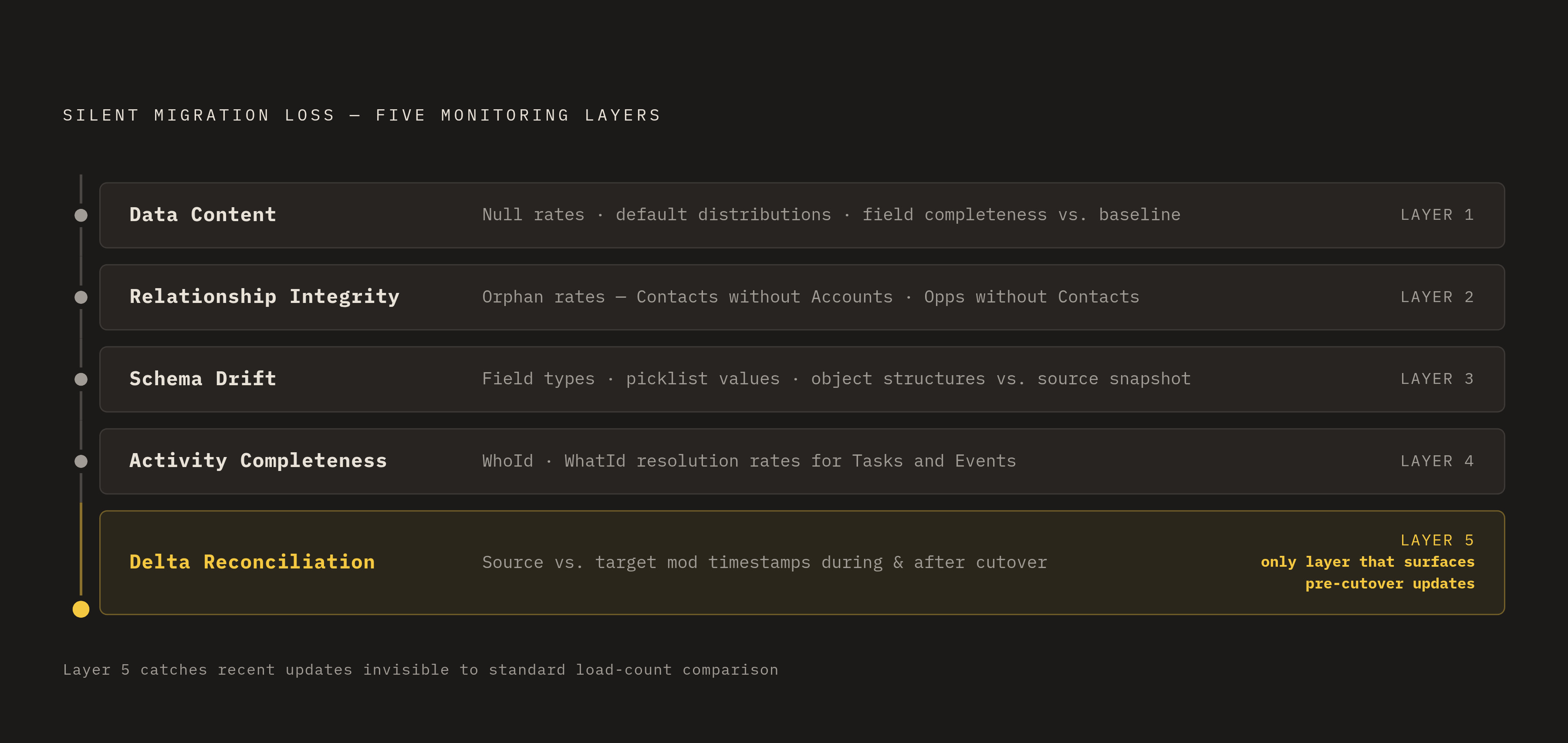
Teams should place continuous monitoring at the system-of-record level. A one-time go-live pass cannot detect later changes, and a downstream alert may arrive after training data has already been consumed. The architecture needs five connected layers. Each should test a specific property that successful row loading leaves unproven.
Data content monitoring should track null rates, default-value distributions, and field-level completeness against the pre-migration baseline. These checks show force-filled defaults and changes that checks for populated fields can miss, including losses from truncation. Relationship integrity monitoring should track orphan rates on their own for the parent-child object pairs that matter, including Contacts without Accounts and Opportunities without Contacts.
Schema drift detection should flag where field types, picklist values, and object structures in the live target differ from those in the source snapshot. This layer addresses changes introduced when automations re-enable and begin writing data in formats the migration did not anticipate. Activity completeness needs its own relational test. WhoId and WhatId resolution rates for Tasks and Events show whether imported engagement records still link to valid destination records.
Delta reconciliation completes the coverage by comparing source and target modification timestamps during and after cutover. A source retained in read-only mode provides the reference for identifying updates missing from the destination. This is distinct from checking extraction totals. It tests whether the target includes the recent changes that an initial-load comparison cannot account for.
At enterprise scale, these checks need more than alert delivery. While an orphan spike waits for human triage, new records, reports, and training inputs can accumulate. The agentic reliability layer should propose fixes with evidence and, when authorized, apply them without waiting for the queue to clear. This distinguishes it from observability alone. For Salesforce, that capability must operate directly on the objects containing duplicates, missing fields, and broken relationships, rather than only on the infrastructure moving them downstream.
What teams should audit immediately if a Salesforce migration is already complete or in progress
For a completed or in-flight migration, teams should first establish whether damaged records have entered AI training pipelines and which source material remains available for repair. The audit should then follow AI impact. Begin with orphan rates for Contacts without Accounts, Opportunities without Accounts or Contacts, and Activities with unresolved WhoId or WhatId values. Measure rates as well as checking that an orphan exists, because how common orphans are determines how widely they distort the affected features.
Next, check whether Tasks and Events retain their structured records and valid linkages or survive only as flat notes. If history was flattened, reconstruction depends on source exports that have not yet been decommissioned. Then compare picklist distributions and numeric ranges between the source snapshot and current target. An Industry default that dominates the data or an unexpected cluster of zero deal values should be checked for a possible mapping, truncation, or default-fill error.
Separately, confirm that OpportunityHistory and OpportunityFieldHistory were exported and loaded. Without them, models that use stage-progression timing get only part of the pipeline history, even if the current Opportunity records look correct. Finally, estimate the delta gap by comparing modification timestamps if the read-only source is still on hand. This establishes the missing recent coverage that training may have inherited.
For teams still migrating, do not retire the source org until all five checks pass against the target. A read-only source preserves the rollback option as new destination history accumulates. After cutover, the same checks must keep running to keep the data reliable. As AI-native CRM capabilities depend more deeply on CRM data for training and inference, defects that once distorted reports can instead drive systematically biased recommendations that go-to-market teams act on at scale.